Search Archives:

Custom Search
Showing posts with label economics. Show all posts

Wednesday, January 29, 2014

Economics, the State of the Union, and the Ever-Dimming Appeal of the GOP

Protester holds sign reading, 'NO LONGER REPUBLICAN'
As State of the Union speeches go, President Obama's 2014 appearance before the joint chambers of congress went well. Of the people who watched the speech, 53% had a "very positive reaction to his speech." Conservatives will no doubt point out that the sample is skewed left, but the poll can hardly be blamed for not including people who refused to watch the speech. The audience was largely Democrat and indie, so the sample is largely Democrat and indie.

Still, there's some nasty news for Republicans here. The CNN flash poll's respondents were "44% Democratic and 17% Republican." Yet, when asked if "the president's policies will move the country in the right direction," 71% said they would -- a number way too high to be explained by Democratic boosterism. That number has to include a lot of indies and even some Republicans. CNN reports that the number of dems in the sample is "about 12 points more Democratic than the population as a whole," so 71-12=59.

But let's not get all teabagger about things and start "unskewing" polls to advantage Republicans. Let's look at numbers that need no adjustment.

Monday, December 02, 2013

America Needs a Raise

Sign mocking Walmart's low wages
For me at least, the most interesting story over the holiday weekend was Black Friday mayhem. Running the search term "Walmart Police" through Google News gained me this little screenshot, which I think sums up the spirit of the day pretty well -- people shot, stabbed, and beaten over prices that are really no better than those in any other sale throughout the year. False scarcity and media hype about "can't-miss" deals can drive people to do things they may not be very proud of in the sober light of Cyber Monday. Our consumerist culture is by nature predatory, with the corporate predators tricking the prey into thinking they're predators too -- which leads to predictable outcomes as consumers compete to "hunt bargains."

Another type of corporate predation was also in the news, as Walmart workers staged Black Friday demonstrations to protest low wages. They're starvation wages, really, which have Walmart employees running food drives for each other and relying on food stamps to survive. What's surprising to me is how little bleed-over there is from one story to the other, despite the fact that they're clearly related. Not only do Walmart workers earn far, far too little for their labor, but the Black Friday chaos stories demonstrate just how lousy a working environment the company's willing to tolerate in order to sell someone a toaster oven. Anyone who can read about the Black Friday frenzies across the nation and think that people who have to deal with that don't deserve a raise... Well, they've got a real interesting definition of "deserve."

And of course, the myth that low wage workers have undemanding, cushy jobs is exposed as BS.

Thursday, October 31, 2013

Deficit Falling at Fastest Rate Since WWII -- And Not Because of Spending Cuts

Pile of cash
Republicans like to say that you can't spend your way to prosperity. Why that statement doesn't get them laughed out of whatever room they're in every time they say it remains one of life's great mysteries. Of course you can spend your way to prosperity; ask any prosperous person. The only wealthy people who haven't spent their way to prosperity are those who've inherited wealth. Even lottery winners spent something to gain all their riches, even if it wasn't much. Wealthy people became wealthy by spending money -- and even by borrowing money.

Conservatives are dead wrong on this point and, indeed, the opposite is actually true -- you can't save your way to prosperity, since you're never going to be able to save more than you make -- or at least, figuring in interest, not much more. It's a case of Republican talking points contradicting other talking points; you can't spend your way to prosperity, but successful people are "risk takers" who put money on the line to get things done. One the one hand, conservatives praise entrepreneurs, on the other, they argue that entrepreneurial efforts are obviously doomed and only a fool would believe that you can spend money to make money. No wonder people who listen to talk radio make no sense at all when they start talking about economics. It's all a muddled mess of contradictory propagandizing with no real connection to how things actually work.

All of this started bouncing around in my head when I read this:

The Hill: The federal budget deficit for fiscal 2013 was $680 billion, the Treasury Department reported Wednesday.

This is the first time that the deficit has fallen below $1 trillion during President Obama's time in the White House.

[...]

The deficit has dropped $409 billion from 2012, when it was $1.089 trillion.

Friday, August 30, 2013

Rush Limbaugh, McCommie

Fast food burger
As you most likely know, fast food workers in several cities staged a strike yesterday. The main demand: a rate of pay of $15 an hour -- a little more than double the federal minimum of $7.25. "When they work hard every day for all day long and they don't get paid enough wages to put food on the table and to support their families, then we as a community suffer," explained  Fran Quigley, a clinical professor at Indiana University McKinney School of Law, who joined workers on the picket line.

But why should Quigley care? After all, you have to assume he makes a bit more than the average fast food worker. If we rule out the fact that he's just a good person and assume he's motivated only by self-interest, he still has a compelling reason to support higher wages for these workers, as USA Today reports:

Taxpayers subsidize workers who earn too little, he said, by paying for food stamps and other entitlement programs in which many low-wage workers participate. Profitable corporations employing such workers often make enough money to increase those workers' wages, Quigley said.
This is the conservative case for raising the minimum wage. And it's a case that conservative blowhard Rush Limbaugh doesn't seem to understand.

Monday, August 12, 2013

Demand Drives Hiring. Period. End of Story.

Cashier checks out customer
Last week, we got one of those good news/bad news jobs reports we're so used to seeing by now. The good news is very good news: new jobless claims are at a 6-year low, suggesting that employment has stabilized and that the days of massive layoffs are behind us. The bad news, according to the Associated Press:

[W]hile most companies have stopped cutting jobs, many remain reluctant to hire. That’s bad news for the roughly 11.5 million Americans who are unemployed and a major reason the unemployment rate is still so high four years after the recession officially ended.

"We have seen a disconnect between the level of hiring and firing," said Bricklin Dwyer, an economist at BNP Paribas.

Ask any rightwinger what's going on here and they blame Obamacare. Healthcare reform is creating the dreaded uncertainty and that uncertainty is keeping employers from hiring.

Thing is though, employers and capital investors aren't panicky types who need hand-holding and therapy before they take a risk. If they were, they'd be in a different line of work. It turns out that, historically, periods of uncertainty have been moments of opportunity, when the opportunistic investors and employers actually have hired more workers in order to take full advantage.

Monday, July 29, 2013

Economic Hardship; the Other Demographic Shift that Dooms the GOP

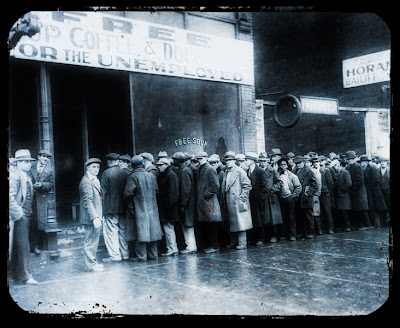
Vintage photo of unemployment line It would be hard to think of a more poorly placed set of priorities. While Americans struggle to get by in an economy that seems to be recovering only for a few, Republicans wage ideological warfare. When employment and the economy should be job one, the GOP has wasted time with nearly forty votes to repeal Obamacare, chased around phantom "scandals," and worked on measures to restrict abortion that have zero chance of ever becoming law. It's bad out there, but the party is acting as if all other problems have been solved, freeing them up to dick around with trivial pet projects.

How bad is it? This bad:

Associated Press: Four out of 5 U.S. adults struggle with joblessness, near poverty or reliance on welfare for at least parts of their lives, a sign of deteriorating economic security and an elusive American dream.

Survey data exclusive to The Associated Press points to an increasingly globalized U.S. economy, the widening gap between rich and poor and loss of good-paying manufacturing jobs as reasons for the trend.
The findings come as President Barack Obama tries to renew his administration’s emphasis on the economy, saying in recent speeches that his highest priority is to “rebuild ladders of opportunity” and reverse income inequality.
Add this to the slow-motion suicide the Republican Party has been committing by trying to alienate everyone. Other than the trickle-down BS that has been disproved by practice so many times,  a hallmark of conservative economic mumbo-jumbo is the belief that people in poor economic situations are there by their own choice -- and if you punish the poor for being poor, the unemployed for being unemployed, their situation will improve. You slash spending on food stamps, cut off people from unemployment benefits, and they'll soon discover that it's too difficult to be poor or unemployed, "pull themselves up by their bootstraps," and just stop be poor. The conservative conception of economic hardship seems to be informed entirely by Ronald Reagan's "welfare queen" myth, not by anything resembling the real world.


↓ CONTINUED AFTER THE JUMP ↓


But why is this approach to economics suicidal for the party of the rich white people? Well, because rich white people are becoming an endangered species. According to the AP, "Hardship is particularly on the rise among whites, based on several measures. Pessimism among that racial group about their families' economic futures has climbed to the highest point since at least 1987. In the most recent AP-GfK poll, 63 percent of whites called the economy 'poor.'"

The "welfare queen" story has always been about dog whistle racism. The politics of division had previously worked so well for Republicans. But now the people struggling to get by are the people they seek to appeal to, while pushing the most unappealing economic policies imaginable to those same people. There are plenty of poor whites who vote Republican -- without checking, I'd guess the majority of them who actually vote -- but at a certain point the law of diminishing returns kicks in and you begin to run out of chumpish poor people. Right now, an NBC News/Wall Street Journal poll finds that "83 percent of Americans disapprove of Congress' job" and "nearly six-in-10 voters say they would vote to defeat and replace every single member of Congress if they had such an option on their ballot."

MSNBC reports that "Republicans are shouldering more of the blame for the situation in the nation's capital: just 22 percent say they believe the GOP is interested in unifying the country in a bipartisan way, versus 45 percent who say the same about Obama."

Those aren't numbers you can win with.

Any those numbers can only get worse. White Americans are learning from personal experience that being economically disadvantaged isn't the sweet deal that everyone in the GOP says it is. Trying to get by on food stamps or unemployment benefits isn't the gravy train and cutting those benefits is the opposite of being helpful. While the racial divide in economic inequality still exists, there's a lot of crossover now and GOP lies are exposed. It's awfully hard to tell someone who's fallen into the social safety net that that net is actually a cushy "hammock."

If it didn't hurt so many people, I would invite Republicans to continue to be economic flatearthers, continue to attack consumer demand wherever it rears its head, and throw themselves off that particular cliff. But the fact is that as the GOP sinks with their own fiscal mismanagement, they're taking a lot of innocent Americans down with them. Unfortunately, they really don't have anything else left. They've mocked real world economics for so long that they can't win a primary espousing anything other than Reaganaut fantasy -- the base demands to be lied to.

So they continue along, ruining lives and harming America, until their con finally runs completely out of steam. Given what that con is doing to the country right now, that end can't come soon enough.

-Wisco

[photo via Wikimedia Commons]


Get updates via Twitter

Monday, February 11, 2013

The GOP plan to preserve the job market status quo

Comic demonstrates folly of trickle-down
Steve Benen brings up a damned good point, as he so often does. In writing about Republicans and the sequestration fight, he points out the the GOP blaming Obama for the sequestration plan is BS and that a major party talking point makes no sense.

...Sen. John McCain (R-Ariz.), who appears to spend more time on Sunday shows than in the Senate, said he's open to some revenues as a way to replace the sequester, but added, "[W]e have raised taxes. Why do we have to raise taxes again?"

Of course, by that logic, there's no reason not to ask, "We have cut spending. Why do we have to cut spending again?"

The question behind these questions is "what future are you preparing for?"

See, it works like this: right now, a major driver of our deficits is unemployment. Employment has been rising, but joblessness is still a major problem. If government is running higher than normal deficits, while cutting spending, it's because there's a revenue shortage caused by all these people out there without income. Contrary to what rightwing hacks tell you, we don't have a spending problem. The problem is that a large chunk the tax base has shrunk.

If you were to cut spending to match this shrunken tax base, that would mean you're preparing for a future where these levels of unemployment are the new normal. After all, cutting spending means cutting demand, which in turn means unemployment. Republicans like to say that it's a bad idea to raise taxes in a recovering economy, but the truth is that it's a much, much worse idea to cut spending when economic times are tight -- which is what Republicans always seem to want to do in their panicky, reactionary little hearts. The plane isn't actually crashing -- we've cleared that danger, it's just some turbulence now -- but Republicans in their reactionary fervor want to tear out seats, jettison luggage, and throw a few stewardesses out the hatch to lighten the load. What Republicans are doing here is literally cheerleading economic panic, in order to score some cheap political points with the few remaining nutjobs still willing to vote for them.

Wednesday, January 30, 2013

Austerity, Spending, and the Stimulative Value of Holes

Construction sign shows man digging hole
An Associated Press article out today could be titled, "Everything Republicans say About Economics Proven Wrong." Instead, we get the less entertaining but just as accurate, "US economy shrinks 0.1 pct., 1st time in 3 1/2 years." If that doesn't sound like good news, that's because it is not. Even a minor contraction in an already deflated economy is enough to cause real worry, like a creaking support beam deep inside a coal mine. But one tenth of one percent isn't exactly a plunge into the danger zone and -- good news! -- we know exactly what caused it. Which means, we also know exactly what to do to fix it.

The U.S. economy unexpectedly shrank from October through December for the first time since 2009, hurt by the biggest cut in defense spending in 40 years, fewer exports and sluggish growth in company stockpiles. The drop occurred despite stronger consumer spending and business investment.

The Commerce Department said Wednesday that the economy contracted at an annual rate of 0.1 percent in the fourth quarter. That was a sharp slowdown from the 3.1 percent growth rate in the July-September quarter.

Economists said the drop in gross domestic product wasn't as bleak as it looked. The weakness was mainly the result of one-time factors. Government spending cuts and slower inventory growth, which can be volatile, subtracted a total of 2.6 percentage points from GDP.

The Reader's Digest Condensed version: austerity sucks. Government spending is the dreaded s-word (i.e., "stimulus") to the US economy. If you cut federal spending, you cut demand, and the economy suffers. Duh.

Wednesday, January 02, 2013

Fiscal Cliff Deal Demonstrates the Fantasy of Trickle-Down Economics

Motivational poster of Reagan staff laughing - 'We told them the wealth would trickle down!'
Last night's passage of the fiscal cliff agreement in the House of Representatives highlights a few important points: that Washington is broken, that a leaderless House GOP is in chaos, that Eric Cantor and John Boehner are working against each other and at cross-purposes, etc. You're going to hear a lot about that in the coming days, so I'm not going to waste your time writing a post you'll be able to read pretty much anywhere else.

Instead, I'm going to use the fiscal cliff deal to demonstrate how Republican explanations of economics are complete BS. As part of the deal (or, more accurately, because the deal completely ignores it), the payroll tax cut holiday will expire, hitting middle- and lower-income workers the hardest. Meanwhile, households over $450,000 and individuals making $400,000 or more will also see their taxes go up. Here's a fun game: guess whose tax hike will slow the economy more, the wealthy's or the rest of us?

Associated Press:

The higher taxes on the wealthy will probably slow the economy a little bit. But a bigger drag would come from a tax increase Democrats and Republicans aren’t even bothering to fight over: the end of a two-year Social Security tax cut. The so-called payroll tax is scheduled to bounce back up to 6.2 percent this year from 4.2 percent in 2011 and 2012, amounting to a $1,000 tax increase for someone earning $50,000 a year.

“It’s a huge hit,” says Joel Naroff, president of Naroff Economic Advisors. “It hits people whether they’re making $10,000 or they’re making $2 million. It doesn’t matter who you are... The lower your income, the more of your income you’re (spending). So if your taxes go up, it’s going to come out of your spending.” And that is bad news for an economy that is 70 percent consumer spending.

Mark Zandi, chief economist at Moody’s Analytics, calculates that the higher payroll tax will reduce economic growth by 0.6 percentage points in 2013. The other possible tax increases — including higher taxes on household incomes above $450,000 a year — will slice just 0.15 percentage points off annual growth, Zandi said.

Tuesday, September 18, 2012

Mitt's Red State Freeloaders

Apparently, Mitt Romney really wants to have this conversation:

There are 47 percent of the people who will vote for the president no matter what. All right, there are 47 percent who are with him, who are dependent upon government, who believe that they are victims, who believe the government has a responsibility to care for them, who believe that they are entitled to health care, to food, to housing, to you-name-it. That that's an entitlement. And the government should give it to them. And they will vote for this president no matter what…These are people who pay no income tax.

Yes, let's talk about all those red state freeloaders. Mitt's wrong about one thing; the majority of non-income taxpayers are red staters, as the map above demonstrates. So let's talk about what a tremendous failure Republican economic policies are. Let's have that conversation.

Thursday, September 06, 2012

Reality-Based Economics

It's obviously largely coincidental, but it seems like reality is trying to punctuate a point Bill Clinton made last night -- that Democratic presidents vastly outperform Republicans in terms of job creation. "Since 1961, for 52 years now, the Republicans have held the White House 28 years, the Democrats 24," Clinton said. "In those 52 years, our private economy has produced 66 million private-sector jobs. So what's the jobs score? Republicans 24 million, Democrats 42 [million]." PolitiFact rates the statement as true.

And today, the Department of Labor reports that "First-time claims for state unemployment benefits declined by the largest amount in more than a month in the latest week."

"The number of initial claims in the week ending Sept. 1 fell 12,000 to 365,000," MarketWatch reports. "The consensus forecast of Wall Street economists was for claims to fall a slight 1,000 to 373,000."

Steve Benen explains, "In terms of metrics, when jobless claims fall below the 400,000 threshold, it's considered evidence of an improving jobs landscape, and when the number drops below 370,000, it suggests jobs are being created rather quickly. We've only managed to dip below the 370,000 threshold seven times in the last 22 weeks, but the more encouraging news is that we've been below 370,000 in six of the last nine weeks."

Monday, December 19, 2011

The Church of the 'Free Market'

Jeb Bush has released a religious tract. It's disguised as an op-ed on economics in the Wall Street Journal, but it's a religious tract.

Congressman Paul Ryan recently coined a smart phrase to describe the core concept of economic freedom: "The right to rise."

Think about it. We talk about the right to free speech, the right to bear arms, the right to assembly. The right to rise doesn't seem like something we should have to protect.

But we do. We have to make it easier for people to do the things that allow them to rise. We have to let them compete. We need to let people fight for business. We need to let people take risks. We need to let people fail. We need to let people suffer the consequences of bad decisions. And we need to let people enjoy the fruits of good decisions, even good luck.

In what way is this a religious tract? Because the argument is backed up only by the strength of Bush's belief. It's a nearly fact-free piece -- the only number he brings up is the population of the United States. He proves nothing, his conclusions are apparently drawn from thin air, his arguments are tired.

Thursday, December 15, 2011

GOP Candidates Unified in Their Love for Failed Economic Policies

A National Review editorial is making some news today, mostly because it pleads with GOP voters to not to support Newt Gingrich. The magazine is still seen as representing the intellectual arm of the Republican Party -- despite the fact that it now features dim bulbs like Jonah Goldberg, Kathryn Jean Lopez, and Rich Lowry -- so there's some news value here. But the same now-undeserved reputation for braininess is why most conservatives won't pay any attention to it. After years of attacking "ivory tower intellectuals," they've managed to get the base to stop listening to them. Nice work, guys. Congrats on your success.

But it's not the anti-endorsement of Newt Gingrich that caught my eye. It was the concise description (in the form of praise) of just about everything that's wrong with the Republican candidates and the party in general.

A hard-fought presidential primary campaign is obscuring the uncharacteristic degree of unity within the Republican party. It has reached a conservative consensus on most of the pressing issues of the day. All of the leading candidates, and almost all of the lagging ones, support the right to life. All of them favor the repeal of Obamacare. Most of them support reforms to restrain the growth of entitlement spending. All of them favor reducing the corporate tax rate to levels that will make the U.S. a competitive location for investment. Almost all of them seem to understand the dangers of a precipitate withdrawal from Iraq and Afghanistan, and of a defense policy driven by the need to protect social spending rather than the national interest. Conservatives may disagree among themselves about which candidate most deserves support, but all of us should take heart in this development -- and none of us should exaggerate the programmatic differences within the field.

I especially like the part about "a defense policy driven by the need to protect social spending rather than the national interest," as if social needs aren't in the national interest -- at least, not like the buying super-important fighter jets we never use. Blowing people up on the other side of the world -- that's in the national interest. Making sure kids at home have enough to eat? That's waste.

Friday, December 09, 2011

GOP Flateartherism Strikes Again

At this point, I have to ask, what do Republicans have against demand? I get that they like this pie-in-the-sky supply-side stuff, but it's "supply and demand," not "supply or demand." At every turn, Republican economic policies have consumers reducing spending, as if a stagnant economy and slow to non-existent growth is the best thing ever.

Case in point:

The Hill:

GOP leaders hope to build momentum for an end-of-year tax package with sweeping reforms to federal unemployment benefits.

The Republican proposal is expected to reduce the total number of weeks unemployed workers are eligible for aid by as much as 40 weeks and tighten rules for eligibility.

Such a reduction would significantly reduce the cost of extending federal unemployment benefits, making it easier to secure GOP support for a measure that will also include an extension of a payroll tax cut many conservative Republicans dislike.

Wednesday, December 07, 2011

Recognizing the Failure of Reaganomics

Nearly every presidential candidate in my memory has promised to change Washington for the better. Politicians need to do things differently, we're told. To work together, to find common ground, to put aside politics for the good of the nation. It all sounds good, but the problem with this promise is that you're promising to change someone else. If Washington doesn't want to change, Washington isn't going to change. And, as we've seen in recent years, if Washington actually wants to get worse, then there isn't a lot any one person can do about it. Barack Obama, like every candidate before him, promised to change the way Washington worked. The problem was that he meant it.

President Obama kept to this centrist, moderate path long after it became clear it didn't lead anywhere. Republicans became a jerking-kneed herd, obstructing anything Democratic, out of a fit of sore-loserism and the belief that political sabotage would pay off for them at the ballot box. Centrism should have died, but Obama seemed to believe there was still some hope. There wasn't. There can probably never be. Democracy is an adversarial system and fighting is built in. A system where one side wins and one side loses once every two years fosters competition, not cooperation. The basic argument behind centrism and moderation is deeply, deeply flawed; that cooperation is more important than the best ideas, that the process is more important than the result.

So it came as both a surprise and a relief when President Obama spoke at Osawatomie, Kansas yesterday. The centrist Obama was mostly absent. Instead, a partisan Obama stepped up to the podium.

Now, just as there was in Teddy Roosevelt’s time, there is a certain crowd in Washington who, for the last few decades, have said, let’s respond to this economic challenge with the same old tune. “The market will take care of everything,” they tell us. If we just cut more regulations and cut more taxes -- especially for the wealthy -- our economy will grow stronger. Sure, they say, there will be winners and losers. But if the winners do really well, then jobs and prosperity will eventually trickle down to everybody else. And, they argue, even if prosperity doesn’t trickle down, well, that’s the price of liberty.

Friday, December 02, 2011

In Payroll Tax Cut Debate, GOP War on Facts Marches On

There are a lot of things to dislike about the modern Republican Party. There's the attitude they have toward what they consider "the other" -- i.e., gays, lesbians, non-Christians, etc. -- that casts nearly every person who doesn't look like they just stepped out of Normal Rockwell print as an obvious enemy of America. There's the authoritarian bent that would control who you love and what you say, that would listen in on your phone calls and torture you pretty much at whim, that would have even minor offenders in prison and loves the death penalty, and would mark every miscarried pregnancy as a potential murder scene and force women to give birth against their will. But the biggest problem with the Republican Party -- in fact, the problem from which almost all of the other problems stem -- is their hostility to plain, provable fact.

From climate to evolution to economics, we see Republicans believing what they'd like to be true, rather than what is true. When Michele Bachmann said that the human papillomavirus (HPV) vaccine (which reduces cervical cancer in women by preventing a very common STD) caused "mental retardation," it wasn't because she had any evidence of it, but because she wanted it to be true. Social conservatives oppose the HPV vaccine because they believe that protection increases sexual activity among teens. Not surprisingly, this isn't true either, for the exact same reason that airbags don't increase car crashes. But Bachmann believes whatever it is she wants to believe, because that's just what Republicans do.

Case in point:

Reuters:

In late-night votes, the Senate, as expected, defeated a Democratic plan that would have extended and expanded the payroll tax cut that is scheduled to expire on December 31.

Tuesday, November 29, 2011

GOP Economic Incoherence

One of the great triumphs of Republican spin has been their ability to convince their base that they don't work for the government. To illustrate this, let's look at the common Republican argument that government doesn't create jobs. They stand there in their suits bought with a government paycheck, in a government-supplied office, with government-supplied staff, telling us -- in all seriousness, mind you -- that the government has never created a single job. Meanwhile, Republican candidates -- at least, those who happen to be governors and former governors -- compete over which created the most jobs in their states. Cognitive dissonance rules the day, as Republicans try to live in what would, to any rational person, be a confusing whirl of conflicting messages and beliefs.

The oddest thing about this is that GOP austerity is actually shedding jobs in the public sector and adding to unemployment.

Washington Post:

[An upcoming report from the National Governors Association and the National Association of State Budget Officers] says that although state general fund revenue increased in 2011 and is expected to increase 2012, it remains $21 billion below 2008 levels. In addition, states are bracing for further reductions in federal aid that are likely to come from Washington’s efforts to slow the growth of the deficit.

The fiscal pressure on states has become a drag on the job market; local and state governments are shedding jobs, even though the private-sector job market has shown signs of improvement.

State and local governments have cut 455,000 jobs since the beginning of 2010, and public-sector jobs account for the smallest share of the nation's employment since the 2008 financial crisis, according to the Bureau of Labor Statistics.

Thursday, September 15, 2011

Louie Gohmert's Brainless and Typically Republican Jobs Plan

By now, it should be obvious to even the most casual observer that Rep. Louie Gohmert is not burdened with the curse of genius. In fact, while there may be a lot of competition for the title of Dumbest Member of Congress, Gohmert is definitely a frontrunner. This is the guy who came up with the ridiculous "terror babies" conspiracy theory, who argued that President Obama was in league with the Muslim Brotherhood, and that passage of hate crimes legislation would lead to Nazism, legalization of necrophilia, pedophilia, and bestiality. This is one underachieving mind.

So it should come as no surprise that he has idiotic ideas about what will and won't create jobs. In a headline-chasing maneuver, Gohmert filed a bill titled the "American Jobs Act" before Democrats filed the President's bill by the same name. So now dems can't pass Obama's bill -- unless they change the name to something like "American Employment Act" or the "Jobs for America Act." That should really set them back about thirty seconds. What a crippling blow from a procedural grandmaster.

But it's not Gohmert's pointless poaching of the title that's so demonstrative of his idiocy -- although it's not a bad one. It's his bill itself. Two whole pages legislation is all it takes to get America back to work, according to Gohmert. And it's what's in this simplistic legislation that shows the true depth of Representative Gohmert's intellectual capacity.

Monday, August 15, 2011

An Unsustainable Free Ride for the Wealthy

Let's start out by talking about a flat tax. At one point, a flat tax was all the rage among conservatives. For many, it's still a fave. When someone on the right talks about "simplifying the tax code," what they really mean is flattening the tax rate. If everyone paid the same percentage and there were very few deductions, everything would be "fairer," they argue. People making a lot of money are "punished for success" by being pushed into a higher tax bracket. Never mind that this "punishment" doesn't seem to be much of a deterrent, since the total number of US millionaires is expected to double by 2020, as the income inequality between the wealthy and everyone else grows at an astonishing clip. The wealthy are gluttons for this particular punishment, apparently.

Now, keep a flat tax -- the conservative favorite -- in mind while you read this quote from an op-ed by Berkshire Hathaway CEO Warren Buffett, one of the richest people in the world.

BuffettLast year my federal tax bill -- the income tax I paid, as well as payroll taxes paid by me and on my behalf -- was $6,938,744. That sounds like a lot of money. But what I paid was only 17.4 percent of my taxable income -- and that's actually a lower percentage than was paid by any of the other 20 people in our office. Their tax burdens ranged from 33 percent to 41 percent and averaged 36 percent.
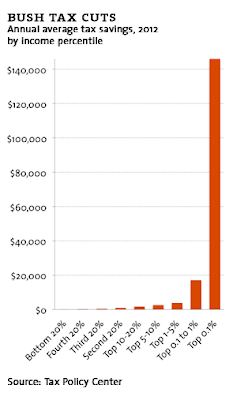
If you make money with money, as some of my super-rich friends do, your percentage may be a bit lower than mine. But if you earn money from a job, your percentage will surely exceed mine -- most likely by a lot.

Monday, April 25, 2011

A Free Ride for Corporations and the Wealthy

It's a terrible thing to be a wealthy person in America. In addition to having to associate with the rabble occasionally, one must also pay taxes. The taxes in America are incredibly high, especially on the wealthy, very wealthy, and stupid wealthy. People with piles of money are an oppressed minority, scorned by the public and taxed to near-starvation. Woe be unto the corporate boardroom set, for their lot is misery and affliction their companion.

Consider this chart showing the terrible tax burden the very wealthy carry, courtesy of Dave Gilson at Mother Jones:

Top 1% lightly taxed


Look at how much the rich are paying in... Oh wait, that says "savings." Never mind.