Search Archives:

Custom Search
Showing posts with label Bush tax cuts. Show all posts

Monday, September 19, 2011

Generals in the Class War Decry Class Warfare

It's not class warfare. It's math.
-President Barack Obama
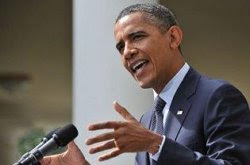

ObamaThat quote was from the president's speech announcing a plan to reduce the deficit. Included in the plan is a choice -- either close tax loopholes that allow the rich and corporations to dodge their fair share of the tax burden or end the high end Bush tax cuts which, as the president rightly pointed out, were intended to be temporary anyway. In fact, when Bush asked congress to make them permanent after the fact, congress refused.

There's no reason that Obama couldn't have demanded both the closure of the loopholes and the end to the bottom heavy tax structure -- none other than Barack Obama being Barack Obama and leading with a concession. But that's another post. This post is about the claims by Republicans that asking the wealthy to pay their fair share is "class warfare."

Los Angeles Times:

Top congressional Republicans on Sunday accused President Obama of trying to incite class warfare with his proposal for a new tax on millionaires and said they would not support the measure because it would hurt economic growth.

"Class warfare … may make for really good politics, but it makes for rotten economics," House Budget Committee Chairman Paul D. Ryan (R-Wis.) said on "Fox News Sunday." "We don't need a system that seeks to prey on people's fear, envy and anxiety. We need a system that creates jobs and innovation and removes these barriers for entrepreneurs to go out and rehire people."

Monday, August 22, 2011

It's Come to This: Republicans Want to Raise Taxes on Consumers

The overthrow of Libyan dictator Moammar Qaddafi is the important story of the day, to be sure. Foreign policy wonk Steve Clemons calls it a "huge win" for both the Libyan people and President Obama, while showing some understandable trepidation over what happens next. Juan Cole breaks down what the event means through the process of elimination, shooting down myths we're sure to see crop up again and again in the coming days and weeks. For once, the story of the day deserves to be the story of the day.

But the problem with the big stories is that they tend to crowd out other stories. With a 24/7 news media, this should not be the case, but it is. It's rational in a sort of televised car chase way; even if nothing's happening right now, it's inevitable that something will -- the chase will end one way or another -- and if you cut away to cover something else, you may miss the big crack up (or, as is more often the case, the anticlimactic peaceful arrest). In this case, if network cameras take their viewfinders off Libya, they may miss the money shot of Qaddafi himself being arrested or gunned down or blown up or even fleeing.

But the real world doesn't cooperate with the media world's programming decisions. Things are scheduled to happen linearly; people in the world aren't waiting for Qaddafi's last hour as dictator to run out before moving on to other things. It all goes on simultaneously, with stories overlapping. If one story becomes the story, other stories get sidelined. Take, for example, the fact that Republicans want to raise taxes on nearly half of Americans:

Associated Press:

News flash: Congressional Republicans want to raise your taxes. Impossible, right? GOP lawmakers are so virulently anti-tax, surely they will fight to prevent a payroll tax increase on virtually every wage-earner starting Jan. 1, right?

Friday, August 05, 2011

The Economy as an Issue is Now 90% Republican-Owned

Last night, Robert Reich made a decent point. Writing about the debt limit deal and yesterday's market sell-off, Reich wonders if Republicans are ready to take ownership of the problem.

John Boehner said Tuesday the Republicans got "90 percent of what we wanted" from the budget deal. So presumably he and his colleagues are willing to take responsibility for some 450 points of today's mammoth 513-point drop in the Dow Jones Industrial Average.

I'm being a bit facetious -- but only a bit. It's always dangerous to read too much into one day's move in the stock market.


Of course, there are a lot of factors that figure into the ongoing dive -- economic uncertainty in Europe, for example -- that have nothing to do with the US. But jitters about jobs and the threat of a double-dip recession are driving a lot of it. If Republicans got 90% of what they wanted from the debt limit deal, then Republicans now own 90% of responsibility for the economy.

Thursday, July 21, 2011

There's Only One Pledge that Should Matter to House GOP -- And It's Not Grover Norquist's

The head of the anti-tax taliban, Americans for Tax Reform's Grover Norquist, just blinked.

Washington Post:

NorquistWITH A HANDFUL of exceptions, every Republican member of Congress has signed a pledge against increasing taxes. Would allowing the Bush tax cuts to expire as scheduled in 2012 violate this vow? We posed this question to Grover Norquist, its author and enforcer, and his answer was both surprising and encouraging: No.

In other words, according to Mr. Norquist's interpretation of the Americans for Tax Reform pledge, lawmakers have the technical leeway to bring in as much as $4 trillion in new tax revenue -- the cost of extending President George W. Bush's tax cuts for another decade -- without being accused of breaking their promise. "Not continuing a tax cut is not technically a tax increase," Mr. Norquist told us. So it doesn't violate the pledge? "We wouldn't hold it that way," he said.


Norquist later walked his statement back a hair. "Any changes in taxes should be kept separate from the budget deal," he said on MSNBC this morning. It's not extremely clear why it should be kept separate from debt limit negotiations, other than the fact that Norquist sensed he'd given away too much. Still, if doing away with Bush's high-end tax cuts doesn't violate the pledge, it doesn't violate the pledge.

Tuesday, June 07, 2011

Bush Tax Cuts are a 10 Year Economic Disaster

Republicans aren't serious about debt reduction. By now, this should be obvious. We're told that Paul Ryan's Medicare-slaying plan is serious, as well as courageous, but the truth is that it's neither. It's silly and it involves the nation hiding its head in the sand. We've fought two wars, largely off-budget, and engaged in the biggest failure of economic policy since Hoover's performance before the Depression. Republicans shoveled money into a hole for eight years, yet we're supposed to believe that Medicare is our big problem. In 2010, our military spending made up nearly half of all world military spending combined, yet we're supposed to believe our problem is that we spend too much on grandma's heart medication.

It wasn't that long ago that I put up this graph, but let's look at it again:

Bush tax cuts the main driver of current and future deficits


The Bush tax cuts came with a lot of promises. We would grow our way out of deficits. Kind of looks like we didn't. Deficits are mindblowing and our economy is a fragile wreck in recovery. As I said the last time I posted that graphic, by every measure and on every promise, the Bush tax cuts failed to deliver.

Tuesday, May 17, 2011

The Bush Tax Cuts Failed. Period

It's a chart that's been making the rounds for a while now. The Center for Budget and Policy Priorities graphed out the main drivers of current and projected deficits and came up with the following:

graph


TARP, bailouts, the stimulus? Ain't crap. And the economic downturn didn't really make much of a dent. The big driver of current and future deficits are the Bush era tax cuts. Although the hole blown in the deficit by the cuts dwarfs them, it pays to point out that we fought two wars -- which Bush made sure were off-budget -- while giving people who could afford to help pay for those wars a free ride.

This isn't pie-in-the-sky liberal loopiness here. These are history, these are facts. We were told that tax cuts would help us "grow our way out of deficits." They didn't. Again, that is fact. We were told the tax cuts would give us a rollicking, healthy economy. Look around you. They failed. That is a fact. In short, every argument in favor of the cuts has failed to materialize. The Bush tax cuts are -- as a simple matter of historical fact -- a complete failure. They are currently zombie policy; dead arguments, inexplicably still shambling around, serving no actual, real world purpose and feeding off the public dime.

Thursday, April 14, 2011

Reality-Based Budgeting

The budget deficit is a multi-generational problem. At least, that's the impression you get if you listen to some in Washington or pretty much any random talking head. If we don't get crazy with the budget scissors, our children and our grandchildren will pay the price. If we do nothing, the nation will be... I don't know, in flames or something.

But yesterday, Annie Lowrey at Slate crunched the numbers and found the real consequence of doing nothing -- eliminating the budget deficit in eight short years.

So how does doing nothing actually return the budget to health? The answer is that doing nothing allows all kinds of fiscal changes that politicians generally abhor to take effect automatically. First, doing nothing means the Bush tax cuts would expire, as scheduled, at the end of next year. That would cause a moderately progressive tax hike, and one that hits most families, including the middle class. The top marginal rate would rise from 35 percent to 39.6 percent, and some tax benefits for investment income would disappear. Additionally, a patch to keep the alternative minimum tax from hitting 20 million or so families would end. Second, the Patient Protection and Affordable Care Act, Obama's health care law, would proceed without getting repealed or defunded. The CBO believes that the plan would bend health care's cost curve downward, wrestling the rate of health care inflation back toward the general rate of inflation. Third, doing nothing would mean that Medicare starts paying doctors low, low rates. Congress would not pass anymore of the regular "doc fixes" that keep reimbursements high. Nothing else happens. Almost magically, everything evens out.
