Search Archives:

Custom Search
Showing posts with label Robert Reich. Show all posts

Wednesday, December 07, 2011

Recognizing the Failure of Reaganomics

Nearly every presidential candidate in my memory has promised to change Washington for the better. Politicians need to do things differently, we're told. To work together, to find common ground, to put aside politics for the good of the nation. It all sounds good, but the problem with this promise is that you're promising to change someone else. If Washington doesn't want to change, Washington isn't going to change. And, as we've seen in recent years, if Washington actually wants to get worse, then there isn't a lot any one person can do about it. Barack Obama, like every candidate before him, promised to change the way Washington worked. The problem was that he meant it.

President Obama kept to this centrist, moderate path long after it became clear it didn't lead anywhere. Republicans became a jerking-kneed herd, obstructing anything Democratic, out of a fit of sore-loserism and the belief that political sabotage would pay off for them at the ballot box. Centrism should have died, but Obama seemed to believe there was still some hope. There wasn't. There can probably never be. Democracy is an adversarial system and fighting is built in. A system where one side wins and one side loses once every two years fosters competition, not cooperation. The basic argument behind centrism and moderation is deeply, deeply flawed; that cooperation is more important than the best ideas, that the process is more important than the result.

So it came as both a surprise and a relief when President Obama spoke at Osawatomie, Kansas yesterday. The centrist Obama was mostly absent. Instead, a partisan Obama stepped up to the podium.

Now, just as there was in Teddy Roosevelt’s time, there is a certain crowd in Washington who, for the last few decades, have said, let’s respond to this economic challenge with the same old tune. “The market will take care of everything,” they tell us. If we just cut more regulations and cut more taxes -- especially for the wealthy -- our economy will grow stronger. Sure, they say, there will be winners and losers. But if the winners do really well, then jobs and prosperity will eventually trickle down to everybody else. And, they argue, even if prosperity doesn’t trickle down, well, that’s the price of liberty.

Wednesday, August 31, 2011

Red State Welfare Queens Revisited

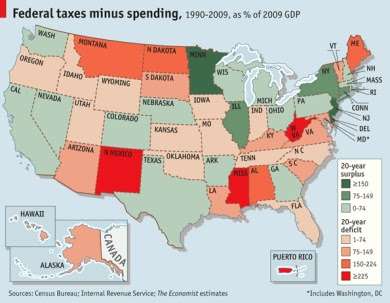
Map chart
I can't figure out why Democrats and liberal commentators don't talk about this more. Especially now, with the Republican Party scrambling to cut pretty much all federal spending. But, for the most part, they aren't. It's not difficult to understand; red state economies are subsidized with blue state money. In other words, the average red state takes more federal tax dollars than it pays in, while blue states take less. I've written about it before. If we wanted to talk about welfare queens living off the largesse of federal government, Republican states are the queens we'd be discussing.

So what does this say about the economics of Republican state governments? Not good things. The ten poorest states in the nation in 2009 were all red states. What happens in red states is the Republican race to the bottom, where they cut services and spending to lower taxes, in hopes of attracting businesses and jobs. But low taxation isn't the only thing businesses are looking for. They want good schools -- not only for their own kids, but because good schools mean good workers. They want a strong infrastructure to maintain their distribution and supply chains. They want local consumers to buy their products or services. Red states offer none of these things and that is a direct result of the "tax cuts are everything" approach to economics.

All of this comes to mind because of a takedown by Robert Reich of Texas Governor Rick Perry. Perry wants "big government" out of our lives (except for the sex police, of course) and has advocated what Reich calls "fiscal secession" from the federal economy -- i.e., each state is on its own, financially. Leaving aside Perry's hypocrisy here, this would be a disaster for voters in most Republican-dominated states.

Friday, August 05, 2011

The Economy as an Issue is Now 90% Republican-Owned

Last night, Robert Reich made a decent point. Writing about the debt limit deal and yesterday's market sell-off, Reich wonders if Republicans are ready to take ownership of the problem.

John Boehner said Tuesday the Republicans got "90 percent of what we wanted" from the budget deal. So presumably he and his colleagues are willing to take responsibility for some 450 points of today's mammoth 513-point drop in the Dow Jones Industrial Average.

I'm being a bit facetious -- but only a bit. It's always dangerous to read too much into one day's move in the stock market.


Of course, there are a lot of factors that figure into the ongoing dive -- economic uncertainty in Europe, for example -- that have nothing to do with the US. But jitters about jobs and the threat of a double-dip recession are driving a lot of it. If Republicans got 90% of what they wanted from the debt limit deal, then Republicans now own 90% of responsibility for the economy.

Tuesday, April 26, 2011

There's a Reason Why "Compromise" and "Reasonable" are Two Different Words

House on fireIt's an argument that I bring up often on this blog; that compromise for the sake of compromise is not a good thing, but a bad thing. Especially when that compromise is between two positions at opposites end of a spectrum. If your house has termites, you might call an exterminator. Or you could listen to your crazy Uncle Stan and burn it down. Only burning half your house down does not qualify as a reasonable compromise -- no matter how insistent Stan's arguments are that it's the only solution. A bad idea is a bad idea. Infusing it with a portion of good idea doesn't improve it, it only ruins the good idea. Some compromises should never be made.
In politics, compromises also suffer from a misperception of the center position. There's the Washington middle and the American middle. The Washington middle -- being a town inhabited by a larger than normal proportion of lunatics -- is almost never where the American middle stands. These days, it's far, far to the right. Where Uncle Stan's idea is to burn the house down, the Republican solution would be to burn the house to the ground, then salt the Earth so that nothing ever grows there again. The "compromise" in Washington would be to embrace Uncle Stan's lunacy wholeheartedly.

Of course, I'm just some guy with a blog. No one's going to listen to me, no matter how solid my arguments are. So maybe if someone like Robert Reich were to make the same damned argument...

Tuesday, March 08, 2011

Sire, The Peasants are Revolting!

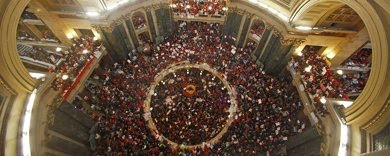
Protesters crowd Wisconsin Capitol
I've been writing almost exclusively about Wisconsin on this blog and I realize that this is a switch from the national perspective I usually take. But I think I can justify it in a few ways: one, I'm in Madison and there's pretty much just one story here and two, Wisconsin is a warning to the country on the dangers of naked Republicanism. There's more here than just a desire to bust unions. That's just part of it. What's really going on is an attempt to move the tax burden off the wealthy and on to everyone else.

Wisconsin State Journal:

Low-income taxpayers in Wisconsin would lose hundreds of dollars in tax credits a year under Gov. Scott Walker’s proposed budget — at the same time the governor wants tax cuts for businesses and investors to boost jobs.

Walker proposes cutting about $16 million a year from the program, which in 2009 paid 273,939 low-income Wisconsin residents a total of $133 million.