Search Archives:

Custom Search
Showing posts with label Tea Party movement. Show all posts

Tuesday, October 25, 2011

99-Percenters Winning the War of Popular Opinion

Wall Street protesters
It's inevitable that comparisons are drawn between the Tea Party and the Occupy movement, as much as people in both groups write off those comparisons. The media, after all, have their narratives and "everyone's freaked out about spending!" has seemingly changed overnight into "everyone wants to take on the wealthy!" So the media's natural reaction is to compare the two movements and see what, if anything, has changed.

But the Tea Party was never an actual movement, in the sense that it was the result of people demanding change. In fact, almost the exact opposite was true -- the people were the result of the "movement." The Tea Party was, is, and always will be a corporate PR stunt -- a guerilla ad campaign -- aimed at getting the rightwing talk radio/Fox News/wingnut blogosphere crowd (i.e., the gullible) out in public demanding that Republicans do what Republicans were already planning on doing.

The Occupy movement, on the other hand, seems to be the result of actual frustration with Washington. Republicans have been blocking everything and talking about "what the American people want," while totally ignoring polling that shows the American people want what the Republicans are blocking. Meanwhile, conservative and centrist Democrats -- including the Obama administration -- have often played along, watering down good legislation or compromising it out of existence. Where the Tea Party embodies manufactured outrage, the 99-percenters' is organic -- and justified.

We see this backed up in polling -- which should surprise no one. A United Technologies/National Journal poll finds "some 59 percent of adults either completely agree or mostly agree with the protesters, while 31 percent mostly disagree or completely disagree" with them. 68% support a tax on the wealthy to pay for the President's jobs plan and "nearly one-third of Republicans -- 31 percent -- completely or mostly agree" with the protesters' goals. Those are goals, by the way, that the media keeps telling everyone are a complete mystery. Apparently, the average voter finds them much less mysterious than the average TV pundit.

Tuesday, October 04, 2011

Real Populism vs. Corporate PR

There is one not so obvious or immediately noticeable difference between the Occupy Wall Street protests and your average Tea Party protest. Sure, the crowds seem to be younger, signs featuring Obama as Hitler are entirely absent, and there aren't many people who are dressed like Uncle Sam sneezed stars and stripes all over them. There are no guns or demands to see the president's birth certificate. But the less obvious difference is in buses. While the Tea Party protests always feature big buses covered with flags and eagles, buses at the Occupy Wall Street demonstrations are used to haul the protesters to jail.

I bring this up because teapartiers like to pretend they're running their own show. That their protests are grassroots and their organizations are of their own construction. But those buses carting them around from protest to protest didn't just appear out of nowhere. Someone paid for them, someone gave them their ultra-patriotic paint jobs, someone's buying all the gas. All that takes funding and, as much as the 'baggers like to pretend they're an independent movement, they're all bought and paid for -- and then moved from square to square like pawns on a chessboard.

On the other hand, Greg Sargent has this to say about the Wall Street protests:

...If there's one thing that's growing clearer by the hour, it's that this is an entirely organic effort, one that's about nobody but the protestors themselves. In this sense, we're seeing a replay of the Wisconsin protests. Those ended up falling just short of what activists had hoped to achieve, but their months-long showing was still important -- it demonstrated that left wing populism is still alive and well and sent an important message about the mood of the country. The key was that it grew organically with little to no involvement from Beltway Dems and the White House.

Wednesday, August 03, 2011

You Can't Win a Fight by Avoiding It

Last week, Democratic pollster Stanley Greenberg wrote an op-ed for the New York Times that made the rounds of lefty blogs. Titled Why Voters Tune Out Democrats, Greenberg made the case that Democrats need to make a push to transform both Americans' perception of government and to eliminate campaign finance laws that favor Republicans.

Those are, of course, the broad strokes; his actual suggestions are more detailed. But the core argument -- or, at least, what I took as the core argument -- was this (emphasis mine):

In analyzing these polls in the United States, I see clearly that voters feel ever more estranged from government -- and that they associate Democrats with government. If Democrats are going to be encumbered by that link, they need to change voters' feelings about government. They can recite their good plans as a mantra and raise their voices as if they had not been heard, but voters will not listen to them if government is disreputable.

Oddly, many voters prefer the policies of Democrats to the policies of Republicans. They just don't trust the Democrats to carry out those promises.

Thursday, April 21, 2011

GOP Candidates Must Walk the Line Between Too Crazy and Not Crazy Enough

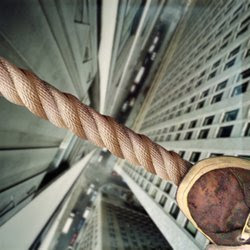
Walking a tightropeAt this point, it would be unrealistic to expect polling on the 2012 presidential race to be predictive. The elections are nineteen months away, give or take a few weeks, and anything could happen between now and then. If you looked at a poll now and said, "This is definitely who's going to win," being right would be as much a matter of luck as anything. It would barely be a better informed choice than using the numbers in your mother's birthday to play the lottery.


But one cliche about polling that's inarguably true is that they're snapshots of a moment in time. It shows you where people's heads are at; what they think is important, what they seem to want, what misconceptions they hold, etc. If not predictive, polls can still be informative.

So looking at a New York Times/CBS News poll out today can tell us a lot about Republican primary voters, even if it doesn't tell us much about who will win that primary. This poll, like a recent CNN poll, finds Republican voters unimpressed with their choices. The NYT poll finds that "nearly 60 percent of Republicans cannot point to a single candidate about whom they are enthusiastic," while CNN's showed "No opinion/No one" in the lead, with 45% of respondents.