Search Archives:

Custom Search
Showing posts with label business. Show all posts

Tuesday, June 18, 2013

In Defense of Private Drones

Private drone with camera
Wonkblog's Timothy Lee has an interesting piece up on the use of commercial drones and states' efforts to come to grips with them. In case you're not familiar with them, these aren't the rather big pilotless aircraft used so controversially by the military. Instead, these are small aircraft like the remote-controlled model planes we're all familiar with -- except they don't look like models of anything. They're generally helicopter-like, with several rotors for increased stability. And, despite the darker associations the word "drone" carries with it, they're extremely useful.

...Because drones are cheap, light and don’t require a pilot, they can be put in the air for a fraction of the cost of a traditional airplane. That has created new opportunities for everyone from real estate firms to oil and gas companies to PETA  – anyone, in fact, who might have use for an eye-in-the-sky, but doesn’t have the money to hire a pilot and a plane. But the dawning era of cheap, private surveillance is leading a lot of states to ask how these private drones should be regulated.

Animal rights groups, for example, have announced plans to use drones to monitor farms for cruelty to animals. Some farmers are upset about the potential invasion of their privacy. So earlier this year, the Idaho legislature passed a drone privacy bill that specifically requires a farmer or rancher’s permission before a “farm, dairy, ranch or other agricultural industry” can be monitored with an unmanned aerial vehicle.

Does such a prohibition violate the First Amendment rights of animal rights advocates? There’s a good chance the answer is “yes,” but the courts have yet to consider the question.
The most obvious use of a private drone is aerial photography. At least, it's obvious to me. And this sort of thing actually isn't all that new. People use kites for the same purpose -- and have for almost as long as photography has existed.

Tuesday, July 12, 2011

Caterpillar Exec to Congress in May: "Make Our Crime Legal"

I was cruising through Reddit last night when this item caught my attention:

Bloomberg News:

Caterpillar Inc. used offshore subsidiaries in Switzerland and Bermuda to avoid about $2 billion in U.S. taxes from 2000 to 2009, boosting its earnings through a "tax and financial statement fraud," according to a Caterpillar executive’s lawsuit.
The company, the world's largest construction-equipment maker, sold and shipped spare parts globally from an Illinois warehouse while improperly attributing at least $5.6 billion of profits from those sales to a unit in Geneva, according to the suit filed by Daniel J. Schlicksup. He was a global tax strategy manager for Caterpillar from 2005 to 2008.

Schlicksup, 49, sued in U.S. District Court in Peoria, Illinois, in 2009, claiming he was moved to a job that limits his career opportunities because he complained to superiors that the "Swiss Structure" ran afoul of U.S. tax rules. He's seeking a court order to give him back his old job and prevent any retaliation. He also seeks stock options that he claims were wrongly withheld as well as legal fees and punitive damages.

Tuesday, March 29, 2011

At This Point, Supply-Side Economics Could Hardly be a Bigger Failure

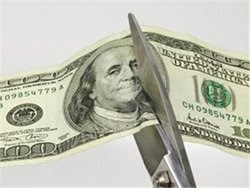
Scissors cutting moneyCut taxes and you create jobs. Cut taxes and you create jobs. Cut taxes and you create jobs...

Say it over and over and it becomes true. Never mind that supply-side reasoning sets basic economics on its head and argues that it's not demand that drives employment, it's low taxation. Cut taxes, create jobs, end of story. It helps that the argument behind supply-side economics almost seems logical; if taxes are lower, businesses can afford to hire more. I say "almost logical" because that's the problem -- it fails to consider history and the facts, considering instead the world the way supply-siders wish it was. It isn't rational.

Demand drives job growth, because employers hire people they need. More demand, more need for workers. A bakery that can't keep up with demand for its bread hires more bakers. It will not hire more bakers than it needs. And if taxes are so low that the bakery is flush despite weak demand, they still won't hire more bakers if they don't need them. Who's going to hire employees to sit around and do nothing, simply because you can afford to? You take that extra money and you put it where it belongs -- in your pocket. You're a business, not a jobs program or a charity.

Tuesday, December 09, 2008

Banks Buy Banks, Workers Get Screwed

The signs say it all. At a nondescript industrial building, sided with corrugated metal, workers display signs that read "Respect Federal WARN Act Law," "You got bailed out. We got sold out," and "$Billion$ for Bank of America, $0 for workers."

The building is the Republic Windows & Doors plant in Chicago and the signs are held by former workers, let go after the company lost its line of credit with Bank of America. The company gave them three days' notice and no severance -- federal law requires 60 days notice and severance. That's the WARN act referred to on the signs. The workers, clearly getting screwed illegally, staged a sit-in and effectively took over the building.

What happened next was unexpected, at least for the workers. "We never expected this," factory worker and union VP Melvin Maclin told the New York Daily News. "We expected to go to jail."

What Maclin and the rest of the Republic workers didn't expect was strong political and governmental support. Political realities in America are quickly correcting themselves after years -- perhaps decades -- of wrongheaded top-down economic theory. The economic crisis is making realists of us all.


"When it comes to the situation here in Chicago with the workers who are asking for their benefits and payments they have earned, I think they are absolutely right," President-elect Barack Obama said sunday at a press conference. "What’s happening to them is reflective of what’s happening across this economy." He went on:

When you have a financial system that is shaky, credit contracts. Businesses large and small start cutting back on their plants and equipment and their workforces. That’s why it’s so important for us to maintain a strong financial system. But it’s also important for us to make sure that the plans and programs that we design aren’t just targeted at maintaining the solvency of banks, but they are designed to get money out the doors and to help people on Main Street. So, number one, I think that these workers, if they have earned their benefits and their pay, then these companies need to follow through on those commitments.


And it's those current "plans and programs" which are the problem here. Not only are they solely "targeted at maintaining the solvency of banks," but they're a multi-billion dollar giveaway without strings. Out of $350 billion handed out in the first round of a $700 billion total bank bailout, only $15 billion is left. According to the Associated Press, "Treasury Secretary Henry Paulson, who is overseeing the program, is weighing tapping the second $350 billion. The main goal of the program is aimed at getting financial institutions to lend money more freely again, which would help revive the economy."

But they aren't lending money. They're using the bailout funds to buy other banks. When "too big to fail" is basically the heart of the problem, allowing them to become even bigger seems stupid beyond words. "[B]anks, both privately and publicly, aren’t talking about helping the economy," reported the investigative jounalism site ProPublica. "They’re talking about helping themselves... The government's investment in the banks, of course, comes with few strings attached and no requirement on how the money can be used." It's a simple calculation; "too big to fail" today may not be "too big to fail" tomorrow. Corporate growth is an insurance policy. Monopolies won't be allowed to go under.

With companies struggling as it is, the absence of available credit is unbearable for many -- like the construction dependent Republic Windows & Doors. Since the idea of the bailout was to increase available credit, we can trace the closing of the Chicago plant directly to the credit crunch. After cutting off Republic's line of credit, Bank of America approved a $50 billion takeover of Merrill Lynch. It had previously acquired LaSalle Bank and Countrywide. Bank of America received $15 billion in bailout funds in November. With the acquisition of Merrill Lynch, they got $10 billion of their bailout bucks -- call it a rebate.

Republic Windows & Doors would've needed somewhere in the neighborhood of $10 million to continue operations. That's chump change to BoA at this point.

Where the feds under Bush wouldn't act, the State of Illinois did. Gov. Rod Blagojevich -- arrested this morning on unrelated charges -- suspended all state business with BoA, Chicago's second-largest bank. Illinois Attorney General Lisa Madigan announced an investigation into the plant closure.

Even after such disastrous consequences for working families, the Treasury seems unlikely to change the merger-mania that their bailout has inspired. In November, they all but announced they were all for it.

Associated Press:

The Treasury official overseeing the federal $700 billion financial bailout plan yesterday defended banks that want to use the government's money to buy competitors.

One of the first deals announced was last month's acquisition of National City Corp. by PNC.

Treasury doesn't want to "micromanage" banks that receive capital infusions under the bailout, Assistant Treasury Secretary Neel Kashkari said at the Wharton Finance Conference in New York.

"Prudent mergers and acquisitions can be good for our financial system and our communities," Kashkari said.


How good was it for the community of Chicago, Illinois? Those people with those signs would probably tell Kashkari "not very." As things are, they're considering spending Christmas occupying the plant.

But wait, there's more. This story may have a happy ending -- at least, for the family who owns Republic.

Chi-Town Daily News:

A company managed by the wife of Republic Windows and Doors owner Richard Gillman recently purchased an Iowa plant that manufactures similar products, according to public records.

Gillman has come under fire in recent days for abruptly closing Republic's Goose Island plant and refusing to provide workers there with the 60 days notice and pay required by federal labor law.

Echo Windows and Doors was created two weeks ago and lists Sharon Gillman as its manager, according copies of records obtained by the Daily News from the Iowa Secretary of the State. According to Cook County property tax records, Sharon Gillman is Richard Gillman's wife.


It's a Christmas miracle! Warms your heart, doesn't it?

-Wisco

Friday, October 17, 2008

The Media Finds a Shiny New Bauble

Obama speaks to Wurzelbacher
It's a case study in missing the damned point. During the final presidential debate, Barack Obama and John McCain spent a fairly good amount of time talking about -- and to -- "Joe the Plumber." Yes, Joe Wurzelbacher's a real guy. He came up because he got a very detailed answer to a tax question at an Obama event. So John McCain brought him up. At this point, Joe the Plumber's importance to America probably should've ended. He was an example and could just as well have been hypothetical. But Joe's real, so the press needed to make a minor celebrity of him. I imagine some stereotypical newspaper editor with a cigar, waving his hands at reporters and talking about "big, big news."

"Go out and find out everything you can about this guy!" Editor Stereotype says, "I want to know how much he makes [about $40k last year], how he votes [Republican], what he pays in taxes [he owes $1,183], is he registered to vote [yes, but his registration is misspelled], how's he feel about the occupation of Iraq [he thinks it's the greatest thing ever]... Go, go, go! America wants to know!"

Like I say, totally missing the point. I got most of that info from the Toledo Blade, but it's all over the media. In fact, Samuel Joseph Wurzelbacher already has his own Wikipedia page.

None of which has a damned thing to do with the context. He was brought in the debate in relation to taxation. Almost none of the "Joe the Plumber" stories have anything to do with that. Wurzelbacher's a freakin' Jeopardy question waiting to happen -- a trivial little sidetrip the media took once. What's important is the context in which he was brought to our attention.

Like I say, he might as well be hypothetical. In fact, given what he told Obama and what the truth is, Wurzelbacher is hypothetical. His situation does not exist.


Joe claims that he's planning on buying a business that makes $250,000 a year and that Obama's tax plan would raise his taxes. Let's not get bogged down in whether this is true or not [turns out it's not], let's explore the example -- you know, the way the media should be dealing with this whole thing.

John McCain continues to claim that small businesses would see their taxes increase under Obama's tax plan. "I will not stand for a tax increase on small business income. Fifty percent of small business income taxes are paid by small businesses," John McCain said in the debate. "That's 16 million jobs in America. And what you want to do to Joe the plumber and millions more like him is have their taxes increased and not be able to realize the American dream of owning their own business." Fifty percent of small business taxes are paid by small businesses? Who's paying the other fifty? We don't go to John McCain for sense. Disregarding whatever the hell it was he was trying to say, he's off the mark when he says small businesses will suffer under an Obama tax policy.

CNN:

"While Obama does favor raising the top two rates, the quote is not true because not all the small business income of those in the top two rates is taxed at the 33% and 35% rates," said Gerald Prante, a senior economist at the nonpartisan Tax Foundation.

The bottom line: McCain's claim only works by using an overly broad definition of what counts as a "small business" - and even with that definition, fewer than 2% of business owners would be hit by Obama's proposed rate increase. For those who are affected, the increase would be levied only on a part of their earnings, not all of them.


Still, the Republican line is "raise taxes on top wage earners, wave goodbye to jobs." But Obama's plan would raise taxes on top earners to roughly the same level as they were before Bush showed up -- i.e., the rate of the Clinton years. Seems to me that worked pretty well.

In fact, the boogeyman of shuttered businesses because of high taxation is more of a straw man, not born out by history. During the fifties, under Eisenhower (a Republican, by the way), the top marginal tax rate was 91% -- that'd be the same fifties that conservatives pine for with all their little hearts. Obama's top marginal rate would be in the neighborhood of 50%. Historically speaking, Obama's increase is modest. And it wouldn't hit people like Wurzelbacher anyway.

And remember all that runaway inflation during the fifties? The massive unemployment? The way all the rich people were so horribly taxed they all became homeless, because they couldn't afford to be rich anymore?

Yeah, that didn't happen. If a top rate of 91% didn't bring America to her knees, it's hard to believe that 50% would. Given reality, John McCain's warnings are as real as Joe the Plumber's license.

But, of course, none of that is what the media is concentrating on -- despite the fact that it was the reason Joe Wurzelbacher was brought up in the first place. No, Joe the Plumber, like Charo or Paris Hilton, is suddenly famous for being famous. You don't care about all that tax stuff, that's boring. What you need to know is what he thinks about Social Security [he's against it] -- despite the fact that he's not running for anything.

If we've learned anything from this, it's that the media is easily distracted by ridiculously trivial crap. Given the opportunity to use a funny moment from a debate to educate the public about the candidates' positions, they didn't take it. What they did was make some right wing nutjob a minor celebrity, while ignoring the reason for his celebrity.

From here on out, how about we pretend that Joe the Plumber is hypothetical? It seems like that's the only way we can get substantive coverage of the example he represents.

-Wisco

Tuesday, September 30, 2008

A Campaign Adrift

Yesterday at Politico, Hillary Clinton's former campaign strategist Mark Penn told us all that Barack Obama has the edge over John McCain on the economy. You hope this wasn't the sort of insight Hillary was paying the big bucks for, since you can turn on CNN and get the same information for free. Breaking news this is not.

In fact, Penn's piece isn't exactly correct, since he argues that it's the stock market and its ripples through the economy that have lifted Obama's poll numbers. But the fact is that McCain's numbers began to fall before Wall Street went all to crap. It was the the downward trajectory of a post-convention bounce for McCain and the slow revelation that Sarah Palin could be outsmarted by a baked potato that began Obama's rise, not the ongoing events of last week and now this week. Worries over the economy haven't hurt, but they're not the cause.


With Reaganomics a burning wreck before us, the party of Reagan loses a lot of its appeal. Penn, an old school corporate suit, doesn't acknowledge this. For him, this is all a reaction to a crisis.

Americans — like voters around the world — have a habit of shifting their support in reaction to a crisis. In 2001, Michael Bloomberg was 20 points behind in New York’s mayoral race, until the Sept. 11 attacks transformed voters’ requirements for the job. New Yorkers needed a crisis manager, not a reformer, and they shifted to Bloomberg virtually overnight.

Over the years, I have seen other such crises have a big impact. President Bill Clinton’s strong and empathetic response to the Oklahoma City bombing in April 1995 lifted his presidency from its doldrums after the 1994 Republican congressional sweep. His reaction to the bombing was a building block toward his easy 1996 reelection. And Sept. 11 transformed the Bush administration into a national security presidency, a key part of his 2004 reelection.


The problem with Penn's analysis -- beside the little timing problem I brought up earlier -- is that Obama's poll numbers aren't limited to the economy. As pollster Rasmussen reported yesterday, Obama not only leads on the economy, but on everything.

While the results for the first presidential debate Friday were mixed, voters in surveys this weekend gave a boost in trust to Barack Obama over John McCain on a cross-section of issues.

Obama is now trusted more on all 10 major issues in new Rasmussen Reports national telephone surveys Saturday and Sunday nights. He even has a statistically insignificant one-point lead over McCain in trust on the handling of the war in Iraq. Just two weeks ago, the Republican had an eight-point lead on this issue.


The proper response by the McCain camp to these numbers would probably involve a lot of swearing; maybe some drinking and crying. You could argue a stock dive (yesterday's second dive doesn't figure into Rasmussen's numbers) boosts Obama because he's not a Republican, but how can that explain a lead on the environment (54%-37%), education (53%-36%), and immigration (43%-40%)? How does it explain Obama's lead on the issue of abortion (47%-42%)? The fact is -- and the numbers back it up -- that the reasons for Obama's rise are much broader than just worries about the economy. He's simply coming across as the most capable and competent candidate.

I've written more than once about Obama's unshakeable calm. Contrast that with McCain's campaign since the conventions -- he's been all over the map, a drama queen who pumps up every little thing into a huge national crisis. Remember "lipstick on a pig?" If you believed McCain, you'd believe it was the worst thing that had ever happened in the history of the human race. When the markets went south, it was a big freakin' emergency and everyone had to drop everything and freak out. And they had to do it nownownow!

Meanwhile, Obama was a rock by comparison. McCain's message of "Don't panic, I'll save you!" wasn't all that comforting, since it suggested that there was reason to panic and that you were in deep trouble. McCain's stunt of "suspending" his campaign and rushing off to Washington looked a lot like histrionics. All Obama really has to do to show better leadership is not act like a panicky horse in a barn fire. People trust Obama's leadership more on every issue because he doesn't act like a lunatic.

In fact, throughout this current situation, McCain's been goofy. He promised not to leave Washington until a bailout deal was brokered, then backpedalled to participate in the first debate. He then took premature credit for getting a deal and House Republicans voted it down. McCain is a candidate on ice, unable to find any footing at all.

Without any sort of compass in a crisis other than these wild Hail Marys designed to bump up his poll numbers, McCain drifts from issue to issue, seemingly unable to do anything other than react. This isn't leadership and it doesn't look like it. This is mad scrambling to save a sinking campaign.

Penn does make one good point though:

Neither Obama nor McCain has so far used the values-oriented approach that President Franklin D. Roosevelt invoked in his first inaugural address, when he described how the “money changers” had fled their temples, allowing government to restore the temple to “ancient truths.” He fused populism with restoring the basic values of hard, honest work over “callous and selfish wrongdoing.”

The candidates are a long way from his rhetoric or his positions — neither has expressed the kind of outrage that FDR did at the bankers who caused so much economic misery. The average American homeowner has already lost 25 percent of the home’s value — for most people, that’s 25 percent or more of their savings.


Then again, FDR didn't run as the FDR history remembers. Economic populism probably wouldn't hurt, but good luck getting that message out. I woke up this morning, flipped through cable news, and on every channel there was some Wall Street type ripping their hair out (if they had any) and demanding a bailout. And those were the cable news financial reporters. Go ahead, try and get a people-centric economic restructuring past corporate hacks like CNN's Ali Velshi. Obama's been talking about a more demand-side focused economy, in the first debate saying, "So my attitude is, we've got to grow the economy from the bottom up," but I wouldn't expect him to go any farther than that. Corporate media would drop him faster than Dennis Kucinich. It's hard to criticize Obama for not making a futile effort.

So Penn's partially right, Obama's on the upswing and the economy is a big part of it. But it's not the only part. The bigger contributor is his opponent, a candidate so determined to win an election that he's shaking himself apart.

-Wisco

Friday, September 26, 2008

McCain's Folly

sinking shipIt's a lovely late autumn morning. The birds are singing, the air is wonderfully cool and seems clean as you breathe it in, the coffee gurgles in the coffee maker, Washington Mutual has gone under -- the largest bank failure in history -- and guys in suits are really freaking out on cable news. The financial wonks are climbing the freakin' walls -- "Where's the bailout?" they ask. "Where's the bailout?" And somewhere in Washington, John McCain quietly craps his pants.

By pretending to be the president and to take the reigns of the economy, McCain set himself up to fail. He doesn't serve on the Senate Banking Committee, so he can't actually help draft an agreement, all he can really do is vote or not for the final bill. He has no real input on a draft. Not only did McCain pretend he was going to do something super-important to fix the economy, but he pretended he could.

I don't know which is worse for John McCain, the truth or the perception. The perception is that House Republicans threw out an all but closed deal in order to help McCain, who managed to show up in Washington after the deal was announced. The truth is that House Republicans, swamped with anti-bailout letters and calls and emails, threw the deal out to help themselves. With the exception of those who've announced their retirements, every single GOP House member is up for re-election in about a month. So they did what Republicans do in a crisis; they panicked.


The House GOP offered their own plan -- two, actually, including one that TIME's Justin Fox calls "a joke."

[The plan from] the House Republican Study Committee, seems to be a joke. It calls for a two-year suspension of the capital gains tax to "encourag[e] corporations to sell unwanted assets." But the toxic mortgage securities clogging up bank balance sheets are worth less now than when they were acquired. Meaning that no capital gains tax would be owed on them anyway. If you repealed the tax, banks would have even less incentive to sell them because they wouldn't be able use the losses to offset capital gains elsewhere. Seriously, where do these people come up with this stuff?


Typical GOP. Use the crisis to push for some kind of tax cut. They seem to be especially attracted to those cuts that don't actually do anything constructive. Another plan, from Republican chief deputy whip, is called "more reasonable-sounding if still pretty vague." That's the advantage of vague. That one calls for the feds to insure more mortgages instead of buying them. House Republicans, no doubt seeing the word "socialist" applied to them more often in a week than they have in their entire lives, seem to believe that nationalizing loss a different way isn't really nationalizing loss.

All of which leaves John McCain pretty much screwed. He thought it would be a good idea, a real masterstroke of political genius, to grab onto this cinderblock of a market and swan dive into the pool. Instead, he finds himself royally screwed. McCain, a man who once said "Economics is not something I've understood as well as I should," seemed to believe that there was the possibility of a solution to this that everyone would like. There's not. The average American doesn't want the bailout at all. The investor class who funds his campaign wants it very, very badly. If there is no bailout, he's screwed. If McCain is credited for a bailout, he's screwed. It doesn't matter whether or not it works. And, although some economists say a bailout isn't necessary, being the man who bravely did nothing doesn't look a lot like leadership.

Hovering over all of this is tonight's debate -- which may or may not happen. Some think that skipping this debate was McCain's plan all along, but the subject was foreign policy and national security. In that debate, McCain did have the most to lose, but few believed he'd actually blow it on those subjects. This should be the debate McCain doesn't want to miss -- the one where he has some idea what the hell he's talking about.

On the subject of the debate, McCain sounds optimistic. "I believe that it's very possible that we can get an agreement in time for me to fly to Mississippi," McCain said. "I understand how important this debate is and I'm very hopeful. But I also have to put the country first."

"Country first" is looking more and more like a slogan. SurveyUSA has been polling the subject of the debate since McCain's big ride to the economy's rescue and public opinion is not trending pro-McCain. Originally, 50% thought the debate should go on. Yesterday, it had risen to 75%. 50% now say they have "no confidence" in McCain on the issue of the economy.

This is what happens when you pretend to be able to do something you can't. John McCain, whose stride had been broken by stumbles at the beginning of all of this, is simply trying to build some econ cred. But, being an economic dope, he's managed only to dig himself in deeper with his bumbling cluelessness.

I wish I could think of more to add here. This was a gross miscalculation on McCain's part, a fumble of epic proportions -- you'd think there would be more to say about it. But I guess the most spectacular explosions are easy to describe -- "It went BOOM!" I could add a bunch of useless words to match the grandeur of McCain's mistake, but all I'd really be doing would be pouring gravy over "he blew it."

-Wisco


BREAKING AS I PUBLISH: McCain backpedals on his original position that he wouldn't leave Washington until a deal was reached. The debate is on.

Tuesday, September 16, 2008

An Adjustment in Strong Fundamentals

broker reacts to numbers on his laptopYesterday was not a good day for the economy, the markets, the United States or, for that matter, the rest of the world. As the Dow dropped more than 500 points, we said goodbye to Lehman Brothers. In related news, Merrill Lynch was traded to the Bank of America for a bologna and cheese sandwich, a can of orange Faygo, and a fun-size Snickers bar. The state of the market was not good.

For his part, President Bush handled the crisis as well as he's handled other crises -- poorly, by trying to BS his way through it. Americans, Bush said, "are concerned about the adjustments that are taking place in our financial markets." See, it's an adjustment, a tiny bump in the road, a little minus-500-point tweak.

Associated Press:

...He said that his administration is focusing on the problem and "working to reduce disruptions and minimize the impact of these developments on the broader economy."

Bush also said he was pleased with work done so far by the Treasury Department, Federal Reserve and major financial institutions to "promote stability" in financial markets shaken by the bankruptcy declaration by Lehman Brothers Holdings Inc. and the sale of Merrill Lynch & Co. to Bank of America.

He acknowledged that such convulsive developments can be "painful for people" directly involved. But Bush also said, "In the long run, I am confident that our capital markets are flexible and resilient and can adjust to these developments."


Of course, as economist John Maynard Keynes so famously pointed out, "In the long run, we're all dead." While it's nice to keep an eye on the future, we live in the present and the present presently sucks. The concerns are immediate, not forecasted.


And no one has a better grasp of those immediate concerns than that great economic mind, Republican John Sidney McCain. Speaking at a campaign event in Jacksonville, Florida, McCain told the crowd, "Our economy, I think, still, the fundamentals of our economy are strong." That didn't go over real well, so McCain redefined what he meant by the "fundamentals."

Think Progress:

During a campaign stop today in Orlando, FL, Sen. John McCain (R-AZ) attempted to defend his repeated claims that the “fundamentals of our economy are strong” by redefining those fundamentals as “workers and small businesses.” “The American worker and their innovation and their entrepreneurship, the small business, those are the fundamentals of America and I think they’re strong,” he said...

As Atrios writes, McCain is now arguing that “if you suggest something is wrong with the economy, you’re insulting workers. This follows the Bush strategy of saying that criticizing his Iraq policies is insulting the troops.”


That'd be a huge shift in policy for supply-sider McCain. Throughout his career, he hasn't done a whole lot for workers, so I doubt he really thinks labor -- the demand-side -- is a "fundamental" of our economy. If you take a look at his tax cut scheme, you see it's Bushian in its top-heavy nature. For McCain, the fundament is at the top, not the bottom. The english language be damned. If you're at the top -- $2.87 million or more a year in income -- you get a %4.4 cut. That works out to more than a quarter million annually. If you're at the bottom, you get a 0.2% tax cut. That works out to be less than 20 bucks. Yay for you. Spend it wisely.

In fact, what we're seeing this week are the result of the kind of economic policies McCain proposes. You only have to look at his economic advisers to see that.

David Corn, MoJo Blog:

If McCain wants to hold someone accountable for the failure in transparency and accountability that led to the current calamity, he should turn to his good friend and adviser, Phil Gramm.

As Mother Jones reported in June, eight years ago, Gramm, then a Republican senator chairing the Senate banking committee, slipped a 262-page bill into a gargantuan, must-pass spending measure. Gramm's legislation, written with the help of financial industry lobbyists, essentially removed newfangled financial products called swaps from any regulation. Credit default swaps are basically insurance policies that cover the losses on investments, and they have been at the heart of the subprime meltdown because they have enabled large financial institutions to turn risky loans into risky securities that could be packaged and sold to other institutions.


Corn then points us to Blooomberg News, who reports that "The immediate problem" with Lehman's collapse was "the derivative default swaps market." Phil Gramm's fingerprints are all over the smoking gun.

Of course, it was Gramm who McCain finally fired for saying the US was in a "mental recession" and that we were a "nation of whiners." Not because of his crazy economic ideas, mind you, but for putting them so bluntly. After firing Gramm, McCain continues to get the same quality of economic advice from new econ adviser David Luskin. That'd be the same David Luskin who wrote this:

Things today just aren't that bad. Sure, there are trouble spots in the economy, as the government takeover of mortgage giants Fannie Mae and Freddie Mac, and jitters about Wall Street firm Lehman Brothers, amply demonstrate. And unemployment figures are up a bit, too. None of this, however, is cause for depression -- or exaggerated Depression comparisons.

[...]

McCain campaign adviser and former U.S. senator Phil Gramm was right in July when he said that our current state "is a mental recession." Maybe he was out of line when he added that the United States has become "a nation of whiners." But when it comes to the economy, we have surely become a nation of exaggerators.


When was this written? Sometime long in the past, when all of the events of yesterday were totally unforeseeable, right?

Wrong. It was written Sunday -- the day before the floor fell out -- and published in the Washington Post, under the title "A NATION OF EXAGGERATORS: Quit Doling Out That Bad-Economy Line." In his op-ed, Luskin also insists that the housing "crisis" (his quotes) is over. Assumedly, everything was supposed to be back to normal. You've also got to assume that, if he actually believes any of this crap, David Luskin took a bath in the market yesterday.

The Obama campaign is right -- McCain is more of the same. As their economic ideology fails spectacularly before their very eyes, Team McCain insists that the ship isn't sinking and there's no reason to deploy the lifeboats. They are supply-siders and banking deregulation moonies in denial. When it all fails, they don't accept their mistakes and adjust to reality, because cultists never accept the shortcomings of their faith. No, they try to convince you that reality isn't what you're seeing right in front of you. Everything is fine. It's just an "adjustment." Reality must adjust to be in accordance with them.

The question Americans need to ask themselves is whether this is the best they can do. If trying the same thing over and over and over, while failing every time, is really the wisest way to go. If slashing regulations and oversight really worked out all that well. Deregulation moonies like to talk about "the genius of the market," a benevolent force that will lift everyone up if you just snap the regulatory chains. But the genius looks more like a moron today. Cut loose from its chains, it ran straight out into traffic.

Don't ask yourself whether you'd vote for John McCain's economic policies. Ask yourself if you'd vote for this market and this economy.

Because this is what McCain's economic policies are.

-Wisco

Friday, August 01, 2008

Corporate Commies

This is how bad the economy is. Once again, Exxon sets the record for profit this quarter -- $11.7 billion. More than any company has ever earned in history. This is bad news for the oil giant, since they didn't do as well as predicted. So, despite making just giant wheelbarrows full of cash, Exxon closed 3% down on the news. Boy, talk about an undervalued stock -- no one's losing money here.

One reason that Exxon didn't do as well as expected is a decrease in production. And that's why we've got to drill, drill, drill. Got to pump up that production. We need oil... Dear Sweet Jesus, we need oil!

But that urgency isn't really reflected in oil companies' spending practices. While we're told that corporations like Exxon are desperate for oil, they sure as hell aren't acting like it.

Associated Press:

The companies insist they’re trying to find new oil that might help bring down gas prices, but the money they spend on exploration is nothing compared with what they spend on stock buybacks and dividends.

It’s good news for shareholders, including mutual funds and retirement plans for millions of Americans, but no help to drivers already making drastic cutbacks to offset the high cost of fuel.

The five biggest international oil companies plowed about 55 percent of the cash they made from their businesses into stock buybacks and dividends last year, up from 30 percent in 2000 and just 1 percent in 1993, according to Rice University’s James A. Baker III Institute for Public Policy.

The percentage they spend to find new deposits of fossil fuels has remained flat for years, in the mid-single digits.


It strikes me that spending less than 10% on oil exploration doesn't do a lot to increase production.

But that's OK. Oil companies don't need to find oil, they know where some is -- where they're not allowed to drill. The reason they can't find oil anywhere other than offshore and in the Arctic National Wildlife Refuge is because they haven't actually been looking.


So production's down, they aren't exploring -- what the hell are they doing? They're slowly becoming socialized, that's what. But this is a very special form of socialism, a form that's becoming widespread in the US; it's the socialization of risk, loss, and overhead, not profit. When corporations make money, they keep it. But when they lose money, you pay -- with tax dollars. And even the markets that corporations operate in are artificial. To stay with our example of big oil, we pay to make it easier for them to sell. The real price of oil isn't paid at the pump, but at every point along the way from extraction to your tank.

Institute for the Analysis of Global Security (IAGS):

The federal government subsidizes the oil industry with numerous tax breaks and government protection programs worth billions of dollars annually. These benefits are designed to ensure that domestic oil companies can compete with international producers and that gasoline remains cheap for American consumers.

Our dependency on oil from countries that are either politically unstable or at odds with the U.S. subjects the American economy to occasional supply disruptions, price hikes, and loss of wealth, which, according to a study [PDF] commissioned by the U.S. Department of Energy, have cost us more than $7 trillion present value dollars over the last 30 years. That is more than the cumulative cost of all of the wars fought by the U.S. since the Revolutionary War. The transfer of wealth to oil-producing countries -- $1.16 trillion over the past thirty years -- significantly increased our trade deficit. The Department of Energy estimates that each $1 billion of trade deficit costs America 27,000 jobs. Oil imports account for almost one-third of the total U.S. deficit and, hence, are a major contributor to unemployment.


In 2007, the US paid $10 billion in energy-related subsidies through tax credits and deductions. Include that in the price of gas, too. What you pay for gas and what you think you pay for gas are probably two very different numbers. These reverse socialists like to talk about the free market, but they really want protection from it. And they get exactly that.

Some in Washington would continue this reverse socialism.

Center for American Progress:

In 2007, [current presidential candidate John] McCain was the only senator who failed to vote on a motion to invoke cloture (thus limiting debate) on the Energy Independence and Security Act. This vote was about whether to close $13 billion in tax breaks for major oil and gas companies to invest in new clean energy technologies such as wind and solar, and efficiency. Sixty votes were required for passage. The motion was rejected 59-40.


In fact, McCain's tax plan includes more tax subsidies for big oil. "Sen. McCain recently proposed to cut the corporate tax rate from 35 percent to 25 percent," we're told. "This would have reduced ExxonMobil and ConocoPhillips taxes by $1.2 billion each in 2007. It would have saved Chevron $480 million in 2007."

And oil's not the only industry that benefits from this socialization of cost and loss. "...the potential for profit encourages people to take risks. But without the potential for loss, you have reckless risk-taking. You have risk-taking without prudence. Without the potential for loss, irresponsibility goes unpunished," NPR's Russel Roberts reported in March.

"The Federal Reserve and the Treasury Department have orchestrated the rescue of Bear Stearns. The defenders of that maneuver argue that if Bear Stearns had failed it would have created a lot of collateral damage, so much collateral damage, that you and I, normal folk who don't know anything about high-falutin' financial instruments like 'collateralized debt obligations' would have been engulfed as well. If Bear Stearns had gone bankrupt, Lehman Brothers might have been next."

So they take the risk, we pay the loss. When Bear Stearns was bailed out by the taxpayers and rival JP Morgan, the Federal Reserve was forced to print new money just to cover it. As it always seems it is in the US these days, corporations profits' are private, while their losses are public. They win, they collect. They lose, you pay.

And the things that actually benefit you directly go ignored. Our infrastructure isn't so much collapsing, as it is rusting away. Associated Press reports that a "review of repairs on each state's 20 most-traveled bridges with structural deficiencies found just 12 percent have been fixed. In most states, the most common approach was to plan for repairs later rather than fix problems now." This was one year after the bridge collapse in Minnesota -- supposedly the wake up call on the state of our infrastructure.

So we're spending money hand over fist (as well as behind the back) to subsidize oil, while we allow the nation's roads to go to hell. It's hard to think of a more screwed up set of priorities.

When some right wing moron calls a lefty "socialist," remember the bass-ackward socialism that's corporate America -- privatize government, but socialize loss. This is what passes for capitalism and free markets these days -- Karl Marx standing on his head.

-Wisco

Technorati tags: ; ; ; ; ; ; ; ; ; ; of the world, unite! You have nothing to lose but your... Well, nothing

Friday, July 18, 2008

One Foot in the Grave

Yesterday, I wrote about a campaign of BS by the right that may rival the propaganda campaign that led us into Iraq. The goal of that campaign is offshore drilling. Almost nothing that's being said by the right has been true -- offshore drilling isn't environmentally safe, China's not already drilling off Cuba, and it won't bring down gas prices.

When I write a post, I often collect more information than I actually need, which means that some examples aren't used in the posts. Usually, these unused stories turn out to be too insane to be representative. It may be tempting to compare some antigay dumbass to Fred Phelps, for example, but it may not be apt. It's kind of like comparing any old right wing zombie to Hitler -- I guess I believe that Godwin's law should be expanded. Similarities are not equations; bad may be bad, but there are degrees of bad, just as there are degrees of BS.

I bring this up to introduce you to a particular group of phonies known as the Congress of Racial Equality (CORE).

Right Wing Watch:

A gathering led by Niger Innis of the Congress of Racial Equality, Bishop Harry Jackson of the High Impact Leadership Coalition, and the new group Americans for American Energy held a press conference yesterday demanding increased “American Energy” production. Their contentions were twofold: that high energy costs disproportionately harm low-income families, and that increased domestic oil drilling would solve the problem. Standing in the way: the “elitist Volvo-driving” environmentalists. Watch:


Although CORE was once a prominent civil rights group, after Niger Innis’s father, Roy, took control in 1968, he led it to the far right, honoring Karl Rove at its Martin Luther King dinner, backing extreme Bush judges, and defending oil companies. According to a Mother Jones article, “Innis has been accused by founder James Farmer and other black leaders of renting out CORE’s historic reputation to corporations like Monsanto and ExxonMobil. (CORE even mounted a counterprotest to environmentalists picketing an ExxonMobil shareholders’ meeting.)”


There's a war on the poor -- by environmentalists. Really? Seems to me that enmity of the poor is a cornerstone of modern Republicanism. After all, it's been the right wing's love of deregulation and hatred of corporate accountability that's screwed the economy. No one's losing their home because some environmentalist is foreclosing on them.

-Continued after the jump-


It was Al Gore's speech on energy yesterday, along with a string of news stories I've been following, that got me thinking about the firebreathing BS vendors above. It turns out that the right wing either doesn't understand the way capitalism works or pretends they don't. We're told that addressing climate change and energy will ruin the economy. It will. In fact, it'll completely destroy it. But capitalism is as destructive as it is progressive. In moving forward, capitalism destroys old industries and markets, replacing them with new ones. It'll destroy the old economic structure while it builds a new one. The structure of the economy in the next ten years won't look anything like it does today. But, of course, that's always been true. The question isn't whether the old structure should be kept alive, but whether the new structure will be as sound. There's no reason to believe it won't be. In fact, since the current energy market relies on crap we have to go find, a new market based on renewables would likely be much more stable in the long run.

Niger Innis and Bishop Jackson aren't representing the poor, they're representing a dying market. They're lobbyists for the buggywhip industry. They're arguing against the steam engine so that sawmills with water wheels won't have to close. They're trying to sell horseshoes in a world that increasingly travels on tires.

They make the mistake that conservatism is almost doomed to make -- they believe that change is bad, unless that change is a reversal. Modern conservatives don't stand for change, unless that change is backward, to the way things used to be.

But, as I said, capitalism is destructive. It destroys old industries and markets, replacing them with new markets and new industries. It sucks for the buggywhip industry, but it's good for everyone else and inevitable regardless. In fact, not only is the world moving away from oil, it's moving away from coal. The fossil fuel industry is, somewhat appropriately, becoming a dinosaur. In fact, it's the fossil fuel industry that's waging a war on workers.

Environmental News Network:

A transition to renewable energy sources promises significant global job gains at a time when the coal industry has been hemorrhaging jobs for years, according to the latest Vital Signs Update released by the Worldwatch Institute.

The coal, oil, and natural gas industries require steadily fewer jobs as high-cost production equipment takes the place of human capital. Many hundreds of thousands of coal mining jobs have been shed in China, the United States, Germany, the United Kingdom, and South Africa during the last two decades, sometimes in the face of expanding production. In the United States alone, coal industry employment has fallen by half in the last 20 years, despite a one-third increase in production.


"Renewables are poised to tackle our energy crisis and create millions of new jobs worldwide," according to Worldwatch Senior Researcher Michael Renner. "Meanwhile, fossil fuel jobs are increasingly becoming fossils themselves, as coal mining communities and others worry about their livelihoods."

The UN Environment Programme (UNEP) agrees. In a recent study, UNEP reported that more than 148 billion dollars had been invested in renewable energy markets worldwide. The report referred to this as a "green energy gold rush."

"Just as thousands were drawn to California and the Klondike in the late 1800s, the green energy gold rush is attracting legions of modern-day prospectors in all parts of the globe," UNEP Executive Director Achim Steiner said.

"What is unfolding is nothing less than a fundamental transformation of the world's energy infrastructure."

And it couldn't come at a better time because -- speaking of a "war on the poor" -- climate change is about to screw us royally. The Environmental Protection Agency (EPA) has released a study that totally undermines the right wing's insistence that change means disaster. To the contrary, not changing means disaster.

"Climate change poses real risk to human health and the human systems that support our way of life in the United States," according to the EPA's Joel Scheraga. The report warns of "a likely increase in food and water-borne germs as the world warms and habitat ranges expand for some disease-causing organisms." This will increase the hardships of which group?

That's right, the poor.

"Many of the expected health effects are likely to fall disproportionately on the poor, the elderly, the disabled and the uninsured," Scheraga warns. Environmentalism isn't waging a war on the poor, it's waging a war on the poor's behalf. Meanwhile, capitalism is doing what it always does -- moving forward and leaving destroyed, obsolete industries and markets in its wake.

What the oil and coal industries -- along with their shills in that video -- want isn't capitalism at all. What they want is protection from capitalism. What they want is to use the power of government to extend the life of their markets artificially. There's no logical reason why they should get it.

"I challenge our nation to commit to producing 100 percent of our electricity from renewable energy and truly clean, carbon-free sources within 10 years," Gore said yesterday.

At the opposite end of the political spectrum, major Bush-backer T. Boone Pickens agrees -- the old generation ways are going the way of the hoop skirt and mustache wax. "For a number of years I’ve watched the wind turbines develop -- and I feel like it’s time for it," Pickens told NPR last month. "I think that oil has peaked at 85 million barrels in the world. We’ve got to develop other forms of energy -- wind, I think solar will be next, and I hope I’m still around to be in the solar deal."

If you're a little lost on the connection between oil and energy production, you could be excused. After all, we don't really burn oil to create electricity. But the future will likely belong to the battery, not the gas tank, and that energy has to come from someplace. Replacing oil with batteries without addressing coal is just switching from oil to coal to get around. Environmentally speaking, this is almost no change.

There is no war on the poor waged by environmentalists. That claim is ridiculous on its face. Chaining people to this creaky and dying market is much more harmful. But, of course, truth isn't the object here. The object is to create an artifical market for a dying industry. These transparent apologist for Exxon represent the last gasp of the buggy whip vendors.

-Wisco

Technorati tags: ; ; ; ; ; ; ; ; ; killed the buggywhip industry and it'll kill the and industries as well

Thursday, April 10, 2008

A Real Solution to Deforestation

They've been called "the lungs of the world." The Amazon rainforest and other old growth forests pull tons of CO2 out of the atmosphere, slowing global warming. In a 2002 report for one of those BS White House programs that have since gone nowhere, it was estimated that one acre of rainforest can sequester between 6 to 72 tons of carbon.

Last year, the Independent reported, "Scientists say one days' deforestation is equivalent to the carbon footprint of eight million people flying to New York. Reducing those catastrophic emissions can be achieved most quickly and most cheaply by halting the destruction in Brazil, Indonesia, the Congo and elsewhere."

It's always bothered me that people seem to have stopped giving a damn about deforestation somewhere back in the '90s. The Independent piece tells us that deforestation accounts for 25% of all greenhouse gases, "while transport and industry account for 14 per cent each."

And here we are dicking around with emissions on cars. While important, vehicle emissions aren't our biggest problem here. We're losing old growth forests and, as these forests are lost, the carbon sequestered in them is released as the wood rots, burns, or is dried in a kiln for lumber. So deforestation is an environmental double-whammy -- not only are you increasing emissions, but you're losing a method of sequestering future emissions.

Part of the problem is that many of the world's old growth forests are in the developing world. It's easy for us to tell them to knock it off, but hard for them to do so. Rainforests and old timber mean money -- and you don't get that money unless you harvest the wood or clear the land for other industries. So the trees come down, acre after acre, tons of carbon are released and future emissions have nowhere to go but the atmosphere.

But there's another way to make money off trees -- carbon credits. A new study shows that global warming could be a boon to the developing world, by offering them a way to monetize forests without destroying them.

Agence France-Presse:

Global carbon markets could generate billions of dollars each year for developing countries that tackle tropical deforestation, a major source of global warming, according to a new study.

Reducing the rate at which Amazonian rain forests are disappearing by only 10 percent, for example, would yield 1.5 to 9.1 billion euros (2.2 to 13.5 billion dollars), depending on world carbon emission prices, researchers calculated.

That money could then be plowed into national conservation efforts that would further mitigate climate change, creating a virtuous circle.

Slow down deforestation by another 20 percent, and the potential income for the region would top 45 billion dollars if carbon prices reached 30 euros per tonne, said the study, one of two dozen scientific papers on the future of the Amazon released Monday by The Royal Society in Britain.


If paying people to leave stuff alone seems a little weird to you, consider that Al Gore and Sir Richard Branson are offering a $25 million prize to anyone who "comes up with the best way of removing significant amounts of carbon dioxide from the atmosphere." So, if you build some big high-tech carbon filter gizmo, you're a gazillionaire (you'll take the prize and sell the gizmo). But leave acres of trees untouched -- which already removes carbon from the atmosphere -- and you're a chump.

Does that make any sense to you?

The problem is that the time to start doing this is now. The AFP piece tells us, "The UN's Intergovernmental Panel for Climate Change (IPCC) has warned that rising global temperatures could transform much of South America's rain forests into semi-arid savannah-like areas within five decades." Grasslands don't sequester a lot of carbon -- trees do that. Killing the rainforests will result in higher temperatures which will make any reforestation impossible. Once gone, it's gone -- and we're royally screwed.

Luckily, this sequestration market already exists. Nine US states and several countries have passed legislation to limit carbon emissions. A key part of these laws is a provision called "cap and trade."

Union of Concerned Scientists:

These systems draw on the power of the marketplace to reduce emissions in a cost-effective and flexible manner. In practice, cap-and-trade systems create a financial incentive for emission reductions by assigning a cost to polluting. First, an environmental regulator establishes a “cap” that limits emissions from a designated group of polluters, such as power plants, to a level lower than their current emissions. The emissions allowed under the new cap are then divided up into individual permits—usually equal to one ton of pollution—that represent the right to emit that amount.


"Because the emissions cap restricts the amount of pollution allowed, permits that give a company the right to pollute take on financial value," we're told. The idea is that companies that operate under their cap can sell their -- I guess you'd have to call it "excess polluting capacity" -- to other industries. If we could bring developing nations into this system, they could sell their sequestration capacity to offset the emissions by polluters. The Amazon alone accounts for a full half of all sequestration capacity on the planet. Add to this further restrictions on emissions and developing technology that commodifies carbon dioxide itself and we could conceivably reduce carbon emissions to near zero.

Meanwhile, we help developing nations create huge national parks or even a new industry of for-profit forestry. The "lungs of the world" would have full-time care.

I can't think of an effort that would have a bigger impact.

--Wisco

Technorati tags: ; ; ; ; ; ; ; ; ; Paying the not to destroy the and other s makes a lot more sense that it may seem

Monday, February 04, 2008

Bush was Wrong -- Again


One of the few joys of living through the presidency of George W. Bush is celebrating the moment when he's inevitably proven wrong. As a prognosticator, Bush is somewhat less accurate than a Magic 8-Ball. Not only did Bush get everything about Iraq wrong, but he even declared the war over years prematurely. This is the man who though he could read Vladimir Putin's mind. "I looked the man in the eye. I found him to be very straight forward and trustworthy and we had a very good dialogue," Bush said. "I was able to get a sense of his soul."

Apparently, Bush's soul-sensing superpowers weren't strong enough to foresee that parking a missile defense system on Putin's borders wouldn't fly. "If the American nuclear potential grows in European territory, we have to give ourselves new targets in Europe," Bush's soulmate said at the time. "It is up to our military to define these targets, in addition to defining the choice between ballistic and cruise missiles."

So, it comes as no surprise that Bush was wrong about the effects of his top heavy tax cuts. See, Bush bought into this whole "supply-side" economic scheme, where you give more money to people who have plenty of money and it all "trickles down" to everyone else. Not surprisingly, this doesn't work.

In theory, the idea is that if you're an employer and can afford to expand or give everyone raises, then that's what you'll do. If you can afford to lower prices, you will. Except this isn't exactly logical. Say you run a company that's making money -- are you going to hire people you just because you can afford to? Are you going to give everyone a raise because you can? Only if you hate money. If there's nothing wrong with your business, why on earth would you "fix" it? Everything's going great, why screw with success?

Take a look at Exxon. Last year, Exxon made more money than any other company in history. And it's not the first time They broke that record. Supply-side economics would dictate that their fabulous success would find its way into your pocket somehow, but you're paying more at the pump. Why? Because that's what corporations do; they make money. As much money as they possibly can. They aren't going to cut gas prices or give the people mopping the office floors a raise merely because they can afford to. They're in the money-making game, not the money-giving-away game. If they make more money, they keep more money. The average consumer be damned. They're in the money collection business, not the money spending business.

And so, Bush and his supporters made a lot of promises about his tax cuts that they couldn't possibly deliver on. This idea that "across the board" tax cuts improve revenues is BS. It didn't work for Reagan. According to Paul Krugman, Reagan "followed his huge 1981 tax cut with two large tax increases. In fact, no peacetime president has raised taxes so much on so many people."

Looking at the failure of Reagan's economic policy, Bush got all Bullwinkle and said, "This time for sure!" It didn't work the last time, but what the hell, give it another try. This time, we'd stick with it regardless the consequences. Deficits be damned. Ronald Reagan's mistake was in being too distracted by the petty concerns of reality. If we go back in time to 2001, we find this fun article by Tom DeLay for the right wing magazine Human Events, where he "debunks" criticism of Bush's tax cuts. In that piece, DeLay claimed that "far from causing deficits, tax relief in conjunction with fiscal discipline can grow our economy out of deficits."

"Growing our way out of deficits" has been the Bush theme on his tax cut scheme. In 2006, Bush told us:


And as a result of a growing economy, we collected more money for the Treasury. I told the American people we would keep spending down and keep pro-growth policies in place to help cut the deficit in half by 2009. As a result of the Mid-Session Review, the numbers that came out of the Mid-Session Review, I'm able to tell the American people we'll cut the deficit in half by 2008. The projected budget deficit over -- of over $420 billion is now assumed to be $296 billion. See, what happens is when you grow the economy by cutting taxes, more tax revenues come into the Treasury, and that's what we're seeing here.


When Bush said he was "able to tell the American people we'll cut the deficit in half by 2008," he wasn't so much right. In fact, like pretty much every damned prediction he's made since he first sat behind the desk in the Oval Office, it was completely, 100% opposite of the eventual facts. Here we are, it's 2008, and Bush's plan for deficit-fighting is pretty much nonexistent.

Associated Press:

n the nation's first-ever $3 trillion budget, President Bush seeks to seal his legacy of promoting a strong defense to fight terrorism and tax cuts to spur the economy. Democrats, who control Congress, are pledging fierce opposition to Bush's final spending plan—perhaps even until the next president takes office.

The 2009 spending plan sent to Congress on Monday will project huge budget deficits, around $400 billion for this year and next and more than double the 2007 deficit of $163 billion. But even those estimates could prove too low given the rapidly weakening economy and the total costs of the wars in Iraq and Afghanistan, which Bush does not include in his request for the budget year beginning Oct. 1.


So much for that, then.

The problem with Bush's economic ideas is that they're basically anti-capitalist. They don't use the markets so much as they go around them. Bush ignores the process and jumps straight to the result. He sees that, when the economy does well, the wealthy have pockets full of money. So, mistaking effect for cause, Bush and supply-siders assume that putting cash into the pockets of the wealthy will help the economy. This isn't economic theory, this is what anthropologist James Frazer called "sympathetic magic." It's the idea that if you lay out the plates, the food will come lay on them.

Imagine the market as an actual market -- in fact, a supermarket. If you want to increase sales, you can hand out coupons and give everyone a good deal. This is retail or "demand-side" economics. And this doesn't just help the store, this helps the consumers by allowing them to spend more. It doesn't stop there.

It helps the grocery's suppliers by moving more product. It helps the employees by offering them more hours. It even helps the local utility -- every time someone opens one of those freezers and compares prices on frozen fishsticks, a happy bell at the generating plant goes "Ka-ching!"

Bush, on the other hand, takes wads of money and stuffs them into the cash drawers. It helps the grocer, but no one else. Capitalism isn't supported this way, it's sidelined. It leaves the market starved. You don't get the system to work unless you actually use it. Money doesn't effect the market if it never enters it.

And the stimulus package, while welcome, isn't going to do a damned thing. As long as we're stuffing the pockets of people at the top of the economic ladder, there's no reason for those people to use the market. It won't change a failing non-system a bit.

So, once again, Bush was wrong. We didn't grow our way out of deficits, we shrank our way into recession. That was the predictable effect -- well, predictable for everyone other than George "Always Wrong" Bush and his band of supply-siders.

--Wisco

Technorati tags: ; ; ; ; ; ; 's policies have been a for the

Tuesday, September 04, 2007

Wal-Mart's High, High Prices

First there was poisoned dog food, then lead paint on toys, toothpaste with antifreeze in it, on and on. It's easy to blame China for these things and we should, but the US shares part of the blame. Asked about the safety crisis with chinese imports by Chris Matthews on Harball, CNBC's Erin Burnett did a little truthtelling.

A lot of people like to say, uh, scaremonger about China, right? A lot of politicians, and I know you talk about that issue all the time. I think people should be careful what they wish for on China. Ya know, if China were to revalue it's currency or China is to start making say, toys that don't have lead in them or food that isn't poisonous, their costs of production are going to go up and that means prices at Wal-Mart here in the United States are going to go up too. So, I would say China is our greatest friend right now, they're keeping prices low and they're keeping the prices for mortgages low, too.


Of course, the way she put it suggests that Erin has the priorities of a pre-ghost Ebenezer Scrooge and the value system of a serial killer. I mean, how low can you really say these prices are when they're accompanied by a casualty count? Who's out there brushing their teeth with antifreeze and thinking, "At least it's cheap?"

The truth is that those low prices come with hidden costs. They're artificially low, because of pressure from US retailers. And those hidden costs are environmental, as well. Writes Dave Zweufel, Editor for The Capital Times, "A recent Wall Street Journalstory, for instance, told of a surprise inspection Chinese investigators pulled on a textile plant in southern China, a plant that makes textile material for the likes of American icons Wal-Mart, Nike and Lands' End."

"Villagers near the plant complained that the factory was turning their nearby river water a dark red," he writes. "The inspectors found a pipe buried underneath the factory floor that was daily dumping 22,000 tons of waste water contaminated with dye from its shirt-making operation."

There's really no such thing as "chinese water," any more than there is chinese air. Eventually, that polluted air and water is distributed around the globe. If you don't wind up with poisoned food, you'll wind up with polluted water eventually. And China's water is incredibly polluted. Believe it or not, these multicolored liquids in these bottles are water samples from lakes and streams.

Water in pastel shades


"Decontaminating the water would have cost big money -- hundreds of thousands a year -- and undoubtedly jeopardized the contracts with the Americans," Zweifel writes. "Dumping the dye into the river was much cheaper." Is drinking whatever the hell that red stuff is worth a couple bucks off on a Barbie doll?

The chinese government admits it has a problem, saying that more than 70% of China's rivers and lakes were polluted in 2005. According to a BBC story at the time, "The China Daily newspaper said that about two million people had suffered diseases caused by drinking water with high arsenic content, including cancer."

Speaking to Stefan Stern of the Financial Times, Mary Teagarden, a professor at the Thunderbird school of global management in Phoenix, Arizona, explained things this way, "Wal-Mart squeezes Mattel [the toy maker], Mattel squeezes its supplier, that supplier squeezes its supplier, and at the end of the chain you have a remote business far out in the countryside that takes a different approach. They don't put lead in paint because they are wicked, it's just what works for them. China is so large, and industrialisation has been so rapid, that maintaining any control over multiple sites is extremely difficult." Everyone puts the squeeze on the guy down the line and, eventually, you wind up with a supplier with no one to squeeze -- so they cut costs in other ways or lose the business.

If you keep cutting corners to cut prices, eventually you'll be forced to cut too deep. And that means environtmental disaster, sweat shops, or lax consumer safety concerns --in many cases, in combination.

Luckily, US consumers understand this. A recent AP-Ipsos poll shows that most americans understand that US companies share some og the blame. According to the report, "[T]here was widespread consensus that plenty of blame can be spread on both sides of the Pacific. Eighty-four percent said Chinese manufacturers and the U.S. businesses which sell Chinese products in this country deserve some or a lot of culpability for the problem."

For its part, mega-marketer Wal-Mart has promised to make changes to its toy safety program. They promise that toys will be tested for safety. But Nu Wexler of Wal-Mart Watch says these promises don't go far enough. "Wal-Mart's not addressing the larger problem of why Chinese toy suppliers are cutting corners with lead paint and melamine," he told the Washington Post. "It's because they're under enormous pressure from buyers like Wal-Mart, and they're sacrificing child safety to keep costs low."

And adult safety, pet safety, worker safety, and the environment. As long as american marketers have the same attitude toward consumer safety and China as Erin Burnett -- putting artificially low prices above every other concern -- these problems will continue.

There's an old saying, "You get what you pay for." If you pay crap for something, you get crap -- like antifreeze in toothpaste and water in lovely pastel shades.

--Wisco

Technorati tags: ; ; ; ; ; ; Marketers like force to cut costs, then pass the savings on to you -- and not in a good way
