Search Archives:

Custom Search
Showing posts with label energy. Show all posts

Monday, April 22, 2013

Overlooked Earth Day

Solar panels
Given the awful week we just went through, it might be easy to overlook Earth Day. After all, terrorist bombings and exploding fertilizer plants and a congress more interested in saving gun manufacturers' profits than in saving American lives aren't problems to be solved by reducing carbon emissions. But the truth is that we need to remember Earth Day now more than ever. If we don't have a survivable environment, none of these other problems will matter. Earth Day comes at a perfect time -- just when we start to lose sight of the importance of the environment, we're reminded that all other problems are of secondary importance.

Fortunately, we're able to walk and chew gum at the same time -- i.e., we don't have to solve problems one at a time, in order of importance. We can deal with terrorism and corporate anarchy and gun fetishism and the environment at once. It's really not that hard. Or, at least, it shouldn't be. But our media makes it more difficult. It's not that the media can't walk and chew gum at the same time -- newspapers prove the opposite. We don't get a big log of paper devoted to one, single subject  on our doorsteps every day. But the electronic media; now there's an example of a one-track mind. The explosion in West, Texas proves that. In any normal circumstance, it would be the story of the year -- but it was unfortunately overshadowed by another tragedy.

Now, I want you to consider how TV coverage of the Boston bomb attacks went. Think back. When you tuned into your favorite cable news network, you spent one helluva lot of time watching talking heads say nothing. They'd learn something new, take the few minutes it took to report that, then yack and yack and yack about nothing. In fact, if you remember correctly, you'll remember that TV media mostly talked about their own coverage; "We're hearing a lot of conflicting reports, so we'll keep you up-to-date when things get clearer." It's an oddity that cable news won't cut away from a story -- even when they have nothing to say -- but the purpose of that is to keep eyes on screens. If you turn on CNN to get news about The Big Story and they're talking about something else, you're switching over to MSNBC. Ratings bias kicks in and we all wind up watching big piles of nothing.

Wednesday, March 16, 2011

Nuclear Plants Run on Tax Dollars

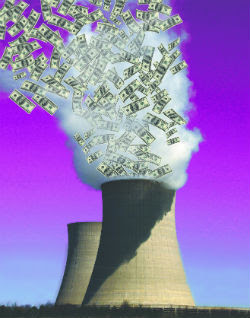
Nuke plant leaking moneyYesterday, I wrote that any new nuclear plants in the US would likely be shoddy. "Take an industry that needs government assistance to survive, add government spending cuts, mix in a whole bunch of deregulation, and you've got a half-assed nuclear facility," I wrote. "This is the way we do things in the new Republican reality -- half-assed, all the way, every time."

We have a Republican party fixated on spending cuts -- to the point where they want to cut funding for tsunami preparedness and have mocked volcano monitoring as an absurd waste of money. They've got deregulation fever, meaning a hands-off approach to industry. And it'd be tough to find one who gave a crap about the environment. So a half-assed nuclear industry it would be, if Republicans had their way.

Over at ThinkProgress, Jeff Spross posts a video demonstrating the GOP's rhetoric on nuclear safety prior to the events in Japan. Not only is it enlightening, but it backs up my argument -- that, for Republicans, "half-assed" and "adequate" are synonymous.


McCain comes out the worst here. In a debate, he dismisses concerns about nuclear safety as an "extreme environmentalist" position. At a campaign event, he portrays it as gibberish, summing up safety concerns as "blah, blah, blah." Like it or not, Republicans are always going to be in American politics and Republicans are sometimes going to be in power. The very existence of the GOP in America is reason enough to believe that safe nuclear power is completely impossible here.

Thursday, August 12, 2010

It's Hot and It's Just Going to Get Hotter

Around the world, people are facing record heat. The UK's Guardian newspaper reports, "Record highs have occurred in Russia, Belarus and Ukraine -- the three nations at the centre of the present eastern European heatwave which has continued for more than three weeks -- but also many African, Middle Eastern and Latin American countries." In all, 17 nations globally have set records, with only one nation -- the west African nation of Guinea -- having reached a record low so far this year. In Russia, the heatwave is contributing to wildfires with the potential of becoming a nuclear disaster.

All of this follows a year that, according to the National Aeronautics and Space Administration, tied for the second warmest on record. NASA also tells us that 2009 marked the end of the "warmest decade on record." Long story short, it's freakin' hot. And a new study by the National Wildlife Federation shows that it's not going to get any better. What we call a "heat wave" today, we'll call the normal tomorrow.


"Global warming is bringing more frequent and severe heat waves and the result will be serious for vulnerable populations," says Dr. Amanda Staudt, a climate scientist with the National Wildlife Federation. "That means air pollution in urban areas could get worse, bringing increased risk of heart attacks, strokes and asthma attacks. Children, the elderly, poor, and people of color are especially vulnerable to these effects." And, of course, this trend brings with it a cyclical problem; more heat means more energy usage. As the mercury rises, thermostats are turned down. We can't be blamed for this really -- excessive heat is extremely dangerous.

"The science confirms that the frequency and duration of heat waves has increased significantly over the last 50 years. In the United States, heat waves already kill more people during a typical year than floods, tornadoes and earthquakes combined," says Peter Wilk, MD, executive director, Physicians for Social Responsibility. "Given these worsening trends, taking decisive action to stop global warming becomes a medical necessity."

In short, we're in the middle of a slow-motion emergency. And this is what it looks like:

The trend is down
Click for full-size graph


That's the trend for arctic sea ice volume from July 1979 to July 2010. As you can see, it's dropping and most recently that drop has become drastic. The world is losing ice because it's getting warmer and warmer and warmer. At this point, the global warmer deniers are operating on pure faith -- the evidence contradicts their wingnut religion.

But hey, look on the bright side. Pretty soon you'll be able to bake a cake by locking a bowl of batter in your car. So that's something. It's not all bad news.

Here's a crazy idea: let's actually do something about this. Do you have any idea what tackling CO2 emissions could do -- especially now? We're talking about new markets and industries. We're talking about bringing manufacturing back to the United States. We're talking about moving from an unsustainable economy where everyone is a paper-shuffler and becoming a nation that actually produces something again. We're talking about the production of actual, real-world, tangible gears and wires and turbines and solar cells, not fancy -- but stupid -- ways to resell our own personal debt to each other.

We need to change our economy and bring back jobs. At the same time, we need to avoid a future where global temperatures are uniformly dangerous. We can kill two birds with one stone. Economically and environmentally, we can't afford not to.

Which begs the question; why aren't we?

-Wisco


Get updates via Twitter


Tuesday, July 20, 2010

Hillbilly Windpower vs. Gleaming Super-Science

Something that's been kind of distracting me lately is wind power. By now, we've all seen the giant wind generators, but what about smaller ones? What got me started on this line of thinking was an online argument about nuclear energy. We're going to have to look at nuclear, the argument went, because other sources of energy were either way to expensive or not viable yet. Ironically, when I brought up the problem of nuclear waste, it was countered with "generation IV" reactors -- these recycle the waste. I say this was ironic because generation IV reactors aren't viable yet either. But the proponent was a nuke disciple and soldiered on with the argument anyway. I also pointed out that nuclear is stupid-expensive -- something I knew a little about, since I'd written about it before. But the disciple countered that wind power costs between $1,200 to $1,300 per kilowatt, which is comparable to nuclear. This struck me as insane. There's no reason wind power should cost that much. It's way too easy to do.

See, you set up a wind generator and you're done, for the most part. There's some maintenance and storage batteries need to be replaced occasionally, but the fuel itself is free. Meanwhile, everything that's true of wind is true of nuclear -- minus the free fuel. You've got to mine it, refine, and enrich it -- none of which are free. And besides, how difficult can it be to generate power from the wind? Turns out, not very difficult at all.


OK, so this is a small generator, but I want you to get a few points from it. First, you could build one. And I don't mean the hypothetical "you" as in "you can buy a 747 if you've got the money," I mean you personally. You could build one. And the reason for this is also my second point: you can make one out of junk. Mr. SlickVideo here made one out of an old treadmill motor and leftover PVC pipe. You could use a washing machine motor or a pump motor or an old car alternator... You get the idea. When it comes to wind -- or solar, for that matter -- we don't need the centralized generation as much. We'd still need it, but mostly as a back up.

So what would it take to generate enough electricity for a home? Let's take a look. We'll forget about Mr. SlickVideo and observe some geeks in their natural habitat.


Did you catch the cost there? About four hundred bucks for the generator, because it's made from the wheel bearing of a junkyard van.

Now I'm not asking anyone to go out and build a wind generator (although, if you want to, knock yourself out). But what I am asking you to do is think about energy differently. Do you know how a nuclear plant generates power? All electrical generators could be called energy converters -- they take one kind of energy and convert it to electricity. In the case of a nuclear plant, the reactor creates heat, which is turned to kinetic energy, which is then converted to electrical energy. The plant is basically a steam engine, which turns a generator. In other words, it works exactly the same way a coal or natural gas plant does. Put as simply as I can, you build a huge radioactive triumph of modern science and technology and you use it to boil water. This strikes me as overkill.

On the other hand, you can use some old crap you found at the junkyard to turn the generator. Either way, miracle of super-science or Sanford & Son, you're turning that generator. Now I ask you, which makes the most sense?

Yes, we're still going to need that centralized power grid and we probably always will -- multiple residence buildings, office buildings, schools, hospitals, etc. are probably too big for the junkyard solution. And everyone else is going to want that grid in times of what I guess we'll have to call "wind drought." But the goal is to reduce carbon emissions, not to eliminate them. Get enough of these things up and running in backyards and parks and parking lots and you'll have gone quite a way toward that goal of reduction. And when they finally break down, you just tear it down and build another one -- using some of the parts of the dead turbine -- because it's all crap that's lying around anyway. If there isn't enough room for a windmill-style generator, stick a vertical turbine on a roof.

I think part of the problem here is that we have a prejudiced view of the future. We grew up thinking it would be ultra-high-tech and shiny, gleaming white and stately. Nuclear looks a lot like the future we imagined. But it may be that the wiser future is steel rods and axle grease, some PVC pipe and the wheel hub from an old tractor. It may be that going green means the ultimate in recycling -- going hillbilly.

And, if it comes down to which future I'd rather live in, I'll take a roofing tin turbine over the gleaming white mystery. The wind generator is simple. I understand it. I've understood it since I built an electric motor in science class in the sixth grade. Like the guys in the second video, I might have built even the generator myself -- and this runs into a simple circuit I wired, into a couple of old motorcycle batteries, and then into a transformer I got for twenty bucks off eBay. It's not nuclear science and that's the beauty. It's no more complicated than it has to be. Nuclear power or wind power, all we're doing here is turning an axle.

-Wisco


Get updates via Twitter


Tuesday, February 24, 2009

Bush's Loose Nukes

Cooling towers at nuclear plantGeorge W. Bush has no plans to retire any time soon. A post at Think Progress reminds us that Bush plans to make "ridiculous" amounts of money on the speaking circuit. While he'd probably be more valuable as a frank and honest witness to his own incompetence, criminality, and hubris, this is George W. Bush we're talking about here. Bush doesn't plan any truth-telling tours, putting all his mistakes on display so we can all learn from them. Former president Bush plans to be exactly like then-president Bush -- three gallons of smart in a fifty gallon drum, with BS making up the difference.

What people will spend the big money to hear will be Baron George Von Munchausen spinning tall tales of his own greatness. That is, if his bio at his agency -- Washington Speakers Bureau -- is any indication:

President George W. Bush served in the Oval Office for eight of the most consequential years in American history. Faced with challenges from a terrorist attack to a global financial crisis, he made difficult decisions that will shape the nation’s course and world affairs for decades to come. His leadership after the terrorist attacks of September 11, 2001, was an inspiration to millions of Americans. His policies, while controversial at times, kept the country safe for more than seven years and liberated more than 50 million people from tyranny.


Say what you like about President George, but he kept us safe -- that is, if you start counting right after the most deadly terrorist attack in American history. If you throw 9/11 into the mix, Bush averages more than one terrorist murder on American soil for every day of his presidency. In the "keeping us safe" category, Bush sucked just as badly as he did at everything else.


But, of course, we aren't supposed to point that out. We're supposed to pretend that 9/11 happened, they turned on the batsignal on top of the White House, and George W. Bush answered the call. We're supposed to pretend that a president eight months into his first term had just moved in and was unpacking. We're suppose to believe that George W. Bush was virtually born on 9/11 and everything that happened before then didn't actually occur.

And Bush would have us dismiss the problems after 9/11 as mere "controversy." For the Bush administration, spin has always been the answer. All problems were problems of public relations and could be fixed with photo-ops, propaganda campaigns, and nifty catch-phrases. And this approach to problem-solving (i.e., problem-not-solving) is still coming back to us.

Government Executive:

A number of institutions with licenses to hold nuclear material reported to the Energy Department in 2004 that the amount of material they held was less than agency records indicated. But rather than investigating the discrepancies, Energy officials wrote off significant quantities of nuclear material from the department's inventory records.

That's just one of the findings of a report released on Monday by Energy Department Inspector General Gregory Friedman that concluded "the department cannot properly account for and effectively manage its nuclear materials maintained by domestic licensees and may be unable to detect lost or stolen material."

Auditors found that Energy could not accurately account for the quantities and locations of nuclear material at 15 out of 40, or 37 percent, of facilities reviewed. The materials written off included 20,580 grams of enriched uranium, 45 grams of plutonium, 5,001 kilograms of normal uranium and 189,139 kilograms of depleted uranium.


"Considering the potential health risks associated with these materials and the potential for misuse should they fall into the wrong hands, the quantities written off were significant," the report tells us. "Even in small quantities normally held by individual domestic licensees, special nuclear materials such as enriched uranium and plutonium, if not properly handled, potentially pose serious health hazards."

Suddenly, I feel a lot less safe -- even in retrospect. "Significant quantities" of nuclear materials are missing and the administration's solution was to fix the numbers so they match. Problem solved. Meanwhile, there are still materials out there somewhere, doing who knows what who knows where for who knows what purpose. Nearly two metric tons of depleted uranium alone are missing; a possible ingredient in a "dirty bomb" -- i.e., a polluting device meant to spread radioactivity and cause panic. That's "keeping us safe," as defined by Bush's Department of Energy.

So Bush can start his new job as historical turd polisher -- he may even manage to get a nice shine on the turd that was his presidency. But it's still a turd and stories like this one will still come out. That's the problem with history; it comes with consequences.

But that's just "controversy." The man born on 9/11 is a big freakin' hero and an example of presidential perfection.

What, you don't believe me?

Ask him yourself.

-Wisco

Monday, December 15, 2008

A Green New Deal

Solar cellsI guess the big news from this weekend is that some guy in Iraq winged a pair of shoes at President Bush's head. All the news reports are telling us that this is a "sign of contempt" in Iraq, but it's hard to think of a place in the world where it would be a sign of anything else. It may not be universal, but it'd still be a pretty clear signal of disrespect anywhere you go -- "And now, in our traditional welcome, we shall batter you with shoes..." Still, shoes must be dirt cheap in Iraq, because you know that guy's probably not getting them back. I'm sticking with flipping the bird. Especially in this economy.

The shoe story has been so big that it's knocked other stories off the front page. Blagejovich has become "Blag-who-evich?" If the Governor of Illinois had known that was all it took to take the media heat off him for a moment or two, he might've hired someone to throw a pair of size 10s himself. That's one way to get a little breathing room.

But the shoe-chucker also knocked a developing story off the media radar this weekend. And that story's bigger than Blago. It's a developing story with international implications. Where the neocons in the Bush administration thought they could rebuild the world by knocking stuff down and blowing people up, others want to rebuild the world by rebuilding the world.


And if there was ever a time that the world needed rebuilding, it's now. The financial crisis is global, leaving no nation untouched. At the same time, we're facing what many recognize as the challenge of our lifetime -- if not of our young century -- global warming. There's a growing consensus out there that these are two problems with a single solution.

UN News Service:

Secretary-General Ban Ki-moon today called for renewed global solidarity to tackle the twin challenges of climate change and the financial crisis, telling ministers gathered at a United Nations conference in Poland that the world cannot afford to let economic woes hinder progress on “the defining challenge of our era.”

[...]

“The world is watching us. The next generation is counting on us. We must not fail,” he told participants from nearly 200 nations, who have been meeting for nearly two weeks as part of UN-led negotiations aimed at reaching an ambitious global climate change deal next year.


Secretary Ban used the term "Green New Deal" to describe what was needed. "An investment that fights climate change, creates millions of green jobs and spurs green growth," he said. "In short, our response to the economic crisis must advance climate goals, and our response to the climate crisis will advance economic and social goals."

This story followed other stories along the same lines. House Speaker Nancy Pelosi used a weekend interview to announce that she'd seek an even larger economic stimulus package than had previously been considered. "This week we had our most recent presentations from economists to tell us what -- how robust such a package should be in order to have an impact on the economy, to turn the economy around," she said on Bloomberg TV's Political Capital with Al Hunt. "Economists told us that the package had to be strong enough, half a trillion, $600 billion, somewhere near that." A large part of that would go toward broader internet access and green energy.

And Barack Obama's thinking even bigger:

Raw Story:

President-elect Obama's transition team may double the size of a planned economic stimulus package in an effort to prevent soaring unemployment.

"Obama aides and advisers have set $600 billion over two years as 'a very low-end estimate,' one person familiar with the matter said," according to a report in Saturday's Wall Street Journal. "The final number is expected to be significantly higher, possibly between $700 billion and $1 trillion over two years."


"We won't do it the old Washington way," Obama said about his stimulus plan earlier this month. "We won't just throw money at the problem. We'll measure progress by the reforms we make and the results we achieve -- by the jobs we create, by the energy we save, by whether America is more competitive in the world."

Some see this as a return to the policies Franklin Roosevelt used to deal with the great depression. "Well, I think the government is back and we're all the better for it," says economic analyst Jeff Madrick. "In fact, the government has been away at least since Ronald Reagan...

"If we spend money at the federal level at propitious times, we can get that bottom we're talking about and begin to recover as well. Unemployment comes down. Incomes rise again... Our infrastructure is a mess. Our education needs reform. We're not attended to our energy needs, people well know now."

Economic theory has been bass-ackward since Reagan. And Bush's policies have only been an exaggeration of that trend. Where government needs to spend when times are bad and build surpluses when times are good, Republicans have been approaching everything in the opposite direction -- only worse. Spend money when times are good, borrow money when things are bad. You don't need to be economic genius to see that that's a bad idea. All the while, we're supposed to keep cutting taxes and expect government to operate on sunshine and happy thoughts. National debt skyrockets, wages stagnate, and the economy relies on paper shufflers who don't actually produce or sell anything.

On the other hand, you need something constructive to spend money on when times are bad. Some argue that it was WWII, not FDR's public works programs, that ended the depression. But that stops making sense when you think about it; we take our nation's wealth, convert it to bombs, and blow it up in Europe. As investments go, blowing up money doesn't strike me as a very good one. It was building bridges and highways and hydro-electric dams, while changing the disastrous environmental practices that led to the dustbowl, that got America on her feet again. Investments in infrastructure are investments that have returns -- we're still enjoying the fruits of those investments today. Had we followed the current Republican economic reasoning, our manufacturing base would've failed -- as it's failing today -- and we wouldn't even have had the capacity to blow up our money in Europe. If that doesn't kill the "war is good for the economy" idea, consider that we're in two wars now -- how's that working out for you? In any case, even the "war is good for the economy" argument admits that government spending helps in hard times.

So we find ourselves in a perfect time to deal with global warming. We need to invest in change, at a time when an investment in change is essential. There's a growing consensus in the world that this investment has to happen and that this investment is the way out of our mutual financial crisis. We've got the government to do it, we've got the means to do it, we've got an international call to do it.

Given that, I say we roll up our sleeves and do it.

-Wisco

Friday, September 19, 2008

Bush Disappears, McCain Wishes He Could

Bush-Quayle buttonWay back when George Bush -- the original recipe one -- was president, there was some suspicion that Vice President Dan Quayle wasn't as stupid as everyone thought he was. The theory went that the White House, realizing that a President Quayle was just never going to happen, decided to use Quayle as Bush's political escape pod. Whenever Bush started getting criticism, Quayle would misspell potato or buy an anatomically correct nutcracker-doll or get a marble stuck up his nose or fall down a manhole and, presto, different headlines. "HOW MUCH DID BUSH KNOW ABOUT IRAN-CONTRA?" could be changed to "QUAYLE WAS AN IDIOT AGAIN" overnight.

I don't give this hypothesis any credence. Quayle later ran for president and he still pops up occasionally as someone who wants to be taken seriously, so I doubt he had agreed to throw his future career out the window. I think this idea works because; 1) Bush was always getting criticism toward the end of his term, and 2) Quayle was always being an idiot. Call it a convergence of PR disasters. But it'd be bad politics all the way around -- most obviously for Quayle, but also for the president who chose him.

I thought of this -- you can't really call it a conspiracy theory, but I guess that's the closest description -- last night when I saw this piece by Politico's Roger Simon:

Where’s George? The president, I mean.

You remember him. Dubya. No. 43. Won a second term a few years ago. It was in all the papers.

But where has he been lately? Where has he been during America’s worst financial crisis since the Great Depression?

Nowhere. AWOL. Every now and then, when the stock market takes yet another sickening plunge, a few words issue forth from the presidential lips. A very few words. Delivered with the greatest reluctance.


If ever there were a president who needed everyone to say, "Hey, look over there!" it's this President Bush. You think you've got scandal fatigue, imagine how he feels about it. The problem is that he's getting exactly the distraction he needs, although it's probably not the distraction he prays for with all his little heart.

The McCain campaign provided that distraction yesterday by imploding.


It was actually fascinating. It began with the news that the post-convention bounce was finally over and McCain's inflated poll numbers deflated. While it seems like Team McCain knew this was coming, it -- perhaps combined with the economic barn fire Monday -- really seems to have thrown them off their game.

In an interview with a Miami radio show, McCain appeared to have confused Spanish Prime Minister José Luis Rodríguez Zapatero with Mexican Zapatista rebels (which he further seemed to confuse with the Colombian FARC) and Spain with Latin America. McCain, clearly lost in the interview, wouldn't say whether or not he'd meet with Zapatero as president. Since Spain is a NATO ally, but not a popular one in the White House after pulling out of Iraq, this sparked speculation that McCain would continue Bush's policy of being pissy about these things. And that was giving McCain the benefit of the doubt. Not giving him the benefit of the doubt would require acknowledging that Mr. Foreign-Policy-Expert didn't know what the hell he was talking about. When someone asks you about a European leader and you start talking about South American drug cartels, something is very, very wrong.

Not to be outdone in the incoherence department, Sarah Palin took a question at a rally about new drilling. How would new fuels from American sources help domestic markets if it could be sold overseas?

Think Progress:

Oil and coal? Of course, it’s a fungible commodity and they don’t flag, you know, the molecules, where it’s going and where it’s not. But in the sense of the Congress today, they know that there are very, very hungry domestic markets that need that oil first. So, I believe that what Congress is going to do, also, is not to allow the export bans to such a degree that it’s Americans that get stuck to holding the bag without the energy source that is produced here, pumped here. It’s got to flow into our domestic markets first.


If you're wondering if that actually means something in English, you're not alone. Allow me to quote The Venture Brothers; "I dare you to make less sense!" Is she calling for a total export ban? That'd be a free market no-no and a violation of current law. Luckily for Team McCain, no one has been able to translate it from BS to English, so it means whatever you want it to mean. This is the woman John McCain said "knows more about energy than probably anyone else in the United States of America." If that's true, we seem to be very screwed.

Speaking of solutions that are illegal, McCain responded to the market meltdown with an entirely hypothetical unconstitutional fix that wouldn't change a damned thing. "The regulators were asleep, my friends," McCain said. "The chairman of the SEC serves at the appointment of the president, and in my view, has betrayed the public trust. If I were president today, I would fire him." The chairman of the Security and Exchange Commission, Chris Cox, is the head of a regulatory agency -- the president can't fire him. And even if he could, this would do what, exactly? Unless McCain has a time machine and can go back and fire him before everything went all to hell, it wouldn't actually do anything constructive. As plans for economic reconstruction go, this isn't one.

This brings us to my favorite bungle of yesterday. Seeing that McCain's plan to hypothetically fire the SEC chair might be seen as divorced from reality, Team McCain sent out this bit of press release fun:

In his rush to score political points on economic disaster, we've heard that at his next event in New Mexico, Senator Obama is about to distort the facts and attack John McCain's call for removing the Chairman of the SEC.


Writes Washington Monthly's Steve Benen, "[It's] entertaining to realize that the McCain campaign is criticizing Obama for something he might say, before he says it, accusing Obama of 'distorting' the facts, before he's even spoken. In other words, the McCain campaign line is, 'Obama might point out how McCain screwed up earlier, and if he does, he's being totally unfair -- because we say so.'" Team McCain clearly knows today is going to be another bad day and they wanted to get a jump on it.

So Bush can disappear into the background like a threatened chameleon, while McCain's campaign draws all the fire from the press. But this Quaylish relationship can't make either of them happy.

-Wisco

Wednesday, August 06, 2008

McSellout

I've been writing about John McCain a lot lately, but let's face it, John McCain's not talking about John McCain and someone has to. Lately, when the media talks about John McCain, it's to repeat some attack McCain's made on Barack Obama. Lately, with the help of a media more concerned with sensationalism than substance, McCain has been able to be a serious candidate for president who doesn't seem to stand for a whole lot.

One of the worst aspects of this whole thing is that no one's looking at the fact that McCain doesn't stand for a whole lot. Mr. Leadership generally leads by following. His opinions go where the votes are or the money is. McCain is a candidate openly for sale.

An example; in June, John McCain opposed a Constitutional amendment to make same sex marriage illegal. He didn't support marriage equality, but he took what would've once been the default Republican opinion on issues like this and said it was up to the states to decide.

But, as I said, that was once the default. That was before Bush's 2004 campaign that highlighted the Homosexual Menaces' Threat to America. McCain was behind the times; the new default was to panic over same sex marriage, foretell the destruction of the family and, with it, the end of America. Under Bush, the GOP has become the party of fear and if your reaction to an issue isn't to try to get everyone to wet their pants over it, then you aren't a real Republican.

So John McCain made a trip to see the Apostles of Republican Jesus, that they might impart their wisdom upon him and anoint him a True Republican. And, lo, so it was done.


McCain had made very public splits from two of the Apostles -- Rod Parsley and John Hagee. It was time to appease the religious right. McCain met with the Apostles of Republican Jesus on June 26. The next day, the scales fell from Baghdad Johnny's eyes and he saw the light. He was now sufficiently freaked out over gay marriage.

Press release from ProtectMarriage.com:

United States Senator John McCain today announced his support for the California Protection of Marriage initiative on the state's November ballot, leaders of the ProtectMarriage.com campaign announced. In an email received by the ProtectMarriage.com campaign, Senator McCain issued the following statement:

"I support the efforts of the people of California to recognize marriage as a unique institution between a man and a woman, just as we did in my home state of Arizona. I do not believe judges should be making these decisions."


A complete U-turn. One that had absolutely nothing to do with the fact that he'd just dumped influential Ohio nut Rod Parsley and the Ohio Republican machine was displeased. It had nothing to do with the fact that the Apostles of Republican Jesus he spoke with the day before were also from Ohio. It had nothing to do with the fact that McCain needed the swing state to have any chance in Hell. Of course, if it wasn't for those reasons, the real reasons he'd abandon a position he'd held for years is anyone's guess.

To be fair, McCain isn't exactly known as an actual activist on the issue of marriage inequality -- a little flip-flop for Ohio's corrupt political machine was no big deal. McCain's activism is saved for another high profile flip-flop -- offshore drilling. McCain had previously opposed offshore drilling, but then this happened:


Public Campaign Action Fund tells us, "McCain has received more than twice as much money from the oil and gas industries in the 2008 cycle than in all other cycles since 1989." Presto-chango-rearrango, McCain's an activist for oil companies.

And some of his donors are really digging deep to give McCain money. McClatchy Newspapers tells us the story of one drilling true believer:

Alice Rocchio is an office manager at the New York headquarters of the Hess Corp., drives a 1993 Chevy Cavalier and lives in an apartment in Queens, N.Y., with her husband, Pasquale, an Amtrak foreman.

Despite what appears to be a middle-class lifestyle, the couple has written $61,600 in checks to John McCain's presidential campaign and the Republican National Committee, most of it within days of McCain's decision to endorse offshore oil drilling.


Not surprisingly, some people find this story a little incredible. It appears that Hess is money-laundering campaign contributions through employees, to give beyond the legal maximum a corporation could give to McCain -- that'd be the same McCain you might remember as a former campaign finance reform champion.

In all, Hess employees have given McCain a subsantial portion part of the $1.2 million he's collected from Big Oil. 73% of that has come after McCain reversed his position on offshore drilling.

In fact, Hess employee contributions to McCain look stupid-suspicious when you get up close. It's like looking at a crooked accountant's books and seeing that he doesn't have a lot of imagination. TPM Election Central supplies the specifics:

J. Barclay Collins, Hess Corp., Attorney, $28,500, 19-Jun
John B. Hess, Hess Corp., Executive, $28,500, 24-Jun
Susan K. Hess, Homemaker, Homemaker, $28,500, 24-Jun
Norma W. Hess, Retired, Retired, $28,500, 24-Jun
John J. O'Connor, Hess Corp., Executive, $28,500, 24-Jun
Lawrence Ornstein, Hess Corp., Senior VP, $28,500, 24-Jun
John Reilly, Hess Corp., Executive, $28,500, 24-Jun
Alice Rocchio, Hess Corp., Office Manager, $28,500, 24-Jun
John Scelfo, Hess Corp., Senior VP of Finance, $28,500, 24-Jun
F. Borden Walker, Hess Corp., Businessman, $28,500, 24-Jun


"Norma W. Hess is the widow of oil magnate and company founder Leon Hess, and Susan K. Hess is the wife of Hess chairman and CEO John Hess.," we're told. All exactly the same amount, most on the same day -- you'd think they'd at least try to hide it.

After all this, where McCain's position had previously been to oppose drilling, he told an audience yesterday, "[W]e need to drill here and we need to drill now."

Drill, drill, drill, drill, drill, drill, drill, drill, drill, drill, drill, drill, drill! Do it now! Freak out! Run! Go, go, go, go, go! For the love of freakin' God, don't stop to think for a second -- just run and drill!

McCain endorsed the Republican stunt in Washington -- a phony session while Congress is in recess. And he did this despite the fact that people in Washington are beginning to forget what Baghdad Johnny looks like -- he hasn't been at work since April.

"Let's start working for the American people and not for ourselves," McCain said yesterday.

That's good advice, John -- why don't you take it?

-Wisco

Technorati tags: ; ; ; ; ; ; ; ; ; ; 's pretty much for sale

Friday, July 18, 2008

One Foot in the Grave

Yesterday, I wrote about a campaign of BS by the right that may rival the propaganda campaign that led us into Iraq. The goal of that campaign is offshore drilling. Almost nothing that's being said by the right has been true -- offshore drilling isn't environmentally safe, China's not already drilling off Cuba, and it won't bring down gas prices.

When I write a post, I often collect more information than I actually need, which means that some examples aren't used in the posts. Usually, these unused stories turn out to be too insane to be representative. It may be tempting to compare some antigay dumbass to Fred Phelps, for example, but it may not be apt. It's kind of like comparing any old right wing zombie to Hitler -- I guess I believe that Godwin's law should be expanded. Similarities are not equations; bad may be bad, but there are degrees of bad, just as there are degrees of BS.

I bring this up to introduce you to a particular group of phonies known as the Congress of Racial Equality (CORE).

Right Wing Watch:

A gathering led by Niger Innis of the Congress of Racial Equality, Bishop Harry Jackson of the High Impact Leadership Coalition, and the new group Americans for American Energy held a press conference yesterday demanding increased “American Energy” production. Their contentions were twofold: that high energy costs disproportionately harm low-income families, and that increased domestic oil drilling would solve the problem. Standing in the way: the “elitist Volvo-driving” environmentalists. Watch:


Although CORE was once a prominent civil rights group, after Niger Innis’s father, Roy, took control in 1968, he led it to the far right, honoring Karl Rove at its Martin Luther King dinner, backing extreme Bush judges, and defending oil companies. According to a Mother Jones article, “Innis has been accused by founder James Farmer and other black leaders of renting out CORE’s historic reputation to corporations like Monsanto and ExxonMobil. (CORE even mounted a counterprotest to environmentalists picketing an ExxonMobil shareholders’ meeting.)”


There's a war on the poor -- by environmentalists. Really? Seems to me that enmity of the poor is a cornerstone of modern Republicanism. After all, it's been the right wing's love of deregulation and hatred of corporate accountability that's screwed the economy. No one's losing their home because some environmentalist is foreclosing on them.

-Continued after the jump-


It was Al Gore's speech on energy yesterday, along with a string of news stories I've been following, that got me thinking about the firebreathing BS vendors above. It turns out that the right wing either doesn't understand the way capitalism works or pretends they don't. We're told that addressing climate change and energy will ruin the economy. It will. In fact, it'll completely destroy it. But capitalism is as destructive as it is progressive. In moving forward, capitalism destroys old industries and markets, replacing them with new ones. It'll destroy the old economic structure while it builds a new one. The structure of the economy in the next ten years won't look anything like it does today. But, of course, that's always been true. The question isn't whether the old structure should be kept alive, but whether the new structure will be as sound. There's no reason to believe it won't be. In fact, since the current energy market relies on crap we have to go find, a new market based on renewables would likely be much more stable in the long run.

Niger Innis and Bishop Jackson aren't representing the poor, they're representing a dying market. They're lobbyists for the buggywhip industry. They're arguing against the steam engine so that sawmills with water wheels won't have to close. They're trying to sell horseshoes in a world that increasingly travels on tires.

They make the mistake that conservatism is almost doomed to make -- they believe that change is bad, unless that change is a reversal. Modern conservatives don't stand for change, unless that change is backward, to the way things used to be.

But, as I said, capitalism is destructive. It destroys old industries and markets, replacing them with new markets and new industries. It sucks for the buggywhip industry, but it's good for everyone else and inevitable regardless. In fact, not only is the world moving away from oil, it's moving away from coal. The fossil fuel industry is, somewhat appropriately, becoming a dinosaur. In fact, it's the fossil fuel industry that's waging a war on workers.

Environmental News Network:

A transition to renewable energy sources promises significant global job gains at a time when the coal industry has been hemorrhaging jobs for years, according to the latest Vital Signs Update released by the Worldwatch Institute.

The coal, oil, and natural gas industries require steadily fewer jobs as high-cost production equipment takes the place of human capital. Many hundreds of thousands of coal mining jobs have been shed in China, the United States, Germany, the United Kingdom, and South Africa during the last two decades, sometimes in the face of expanding production. In the United States alone, coal industry employment has fallen by half in the last 20 years, despite a one-third increase in production.


"Renewables are poised to tackle our energy crisis and create millions of new jobs worldwide," according to Worldwatch Senior Researcher Michael Renner. "Meanwhile, fossil fuel jobs are increasingly becoming fossils themselves, as coal mining communities and others worry about their livelihoods."

The UN Environment Programme (UNEP) agrees. In a recent study, UNEP reported that more than 148 billion dollars had been invested in renewable energy markets worldwide. The report referred to this as a "green energy gold rush."

"Just as thousands were drawn to California and the Klondike in the late 1800s, the green energy gold rush is attracting legions of modern-day prospectors in all parts of the globe," UNEP Executive Director Achim Steiner said.

"What is unfolding is nothing less than a fundamental transformation of the world's energy infrastructure."

And it couldn't come at a better time because -- speaking of a "war on the poor" -- climate change is about to screw us royally. The Environmental Protection Agency (EPA) has released a study that totally undermines the right wing's insistence that change means disaster. To the contrary, not changing means disaster.

"Climate change poses real risk to human health and the human systems that support our way of life in the United States," according to the EPA's Joel Scheraga. The report warns of "a likely increase in food and water-borne germs as the world warms and habitat ranges expand for some disease-causing organisms." This will increase the hardships of which group?

That's right, the poor.

"Many of the expected health effects are likely to fall disproportionately on the poor, the elderly, the disabled and the uninsured," Scheraga warns. Environmentalism isn't waging a war on the poor, it's waging a war on the poor's behalf. Meanwhile, capitalism is doing what it always does -- moving forward and leaving destroyed, obsolete industries and markets in its wake.

What the oil and coal industries -- along with their shills in that video -- want isn't capitalism at all. What they want is protection from capitalism. What they want is to use the power of government to extend the life of their markets artificially. There's no logical reason why they should get it.

"I challenge our nation to commit to producing 100 percent of our electricity from renewable energy and truly clean, carbon-free sources within 10 years," Gore said yesterday.

At the opposite end of the political spectrum, major Bush-backer T. Boone Pickens agrees -- the old generation ways are going the way of the hoop skirt and mustache wax. "For a number of years I’ve watched the wind turbines develop -- and I feel like it’s time for it," Pickens told NPR last month. "I think that oil has peaked at 85 million barrels in the world. We’ve got to develop other forms of energy -- wind, I think solar will be next, and I hope I’m still around to be in the solar deal."

If you're a little lost on the connection between oil and energy production, you could be excused. After all, we don't really burn oil to create electricity. But the future will likely belong to the battery, not the gas tank, and that energy has to come from someplace. Replacing oil with batteries without addressing coal is just switching from oil to coal to get around. Environmentally speaking, this is almost no change.

There is no war on the poor waged by environmentalists. That claim is ridiculous on its face. Chaining people to this creaky and dying market is much more harmful. But, of course, truth isn't the object here. The object is to create an artifical market for a dying industry. These transparent apologist for Exxon represent the last gasp of the buggy whip vendors.

-Wisco

Technorati tags: ; ; ; ; ; ; ; ; ; killed the buggywhip industry and it'll kill the and industries as well

Thursday, June 26, 2008

Climate and Energy for Dummies and Fascists

Writing for The Nation, Mark Hertsgaard assures us that "the United States is finally going to have a President who takes climate change seriously enough to do something about it." Does he have the inside scoop on who's going to win?

No. His argument is that both Obama and McCain have said that climate issues will be a top priority for their administrations. Hertsgaard points out that McCain's environmentalism is much weaker than Obama's -- pointing, as I have, to McCain's ludicrous misrepresentation of "cap and trade." But a weak enviro president is better than what we have. Bush seems to actually hate the environment. He's certainly doing what he can to punish it.

Things that absolutely must be done -- like a global end to coal burning -- seem completely beyond McCain, who's environmentalism is restricted by his position in the corporate pocket.

Of course, a new report may change the Republican outlook on environmental issues. The police state party can now look at global warming as a security issue.

Washington Post:

U.S. intelligence agencies have concluded that global climate change will worsen food shortages and disease exposure in sub-Saharan Africa over the next two decades, creating operational problems for the Pentagon's newest overseas military command.

"Without food aid, the region will likely face higher levels of instability, particularly violent ethnic clashes over land ownership," probably creating "extensive and novel operational requirements," for the fledgling U.S. Africa Command, according to a National Intelligence Assessment on the security implications of climate change by the National Intelligence Council.


There you go then, the "safety above liberty" folks -- who include John McCain -- have one more security threat to freak out about. That should make them happy, but probably won't. They're too deeply entrenched in their Bushian enmity with the planet -- the Earth is a threat to the American Way and must be eliminated.

Of course, the threat to international stability is obvious. So obvious that this isn't the first time it's been brought up. Over a year ago, UN Secretary General Ban Ki Moon warned us about it, using Darfur as an example.

It is no accident that the violence in Darfur erupted during the drought. Until then, Arab nomadic herders had lived amicably with settled farmers. A recent Atlantic Monthly article by Stephan Faris describes how black farmers would welcome herders as they crisscrossed the land, grazing their camels and sharing wells. But once the rains stopped, farmers fenced their land for fear it would be ruined by the passing herds. For the first time in memory, there was no longer enough food and water for all. Fighting broke out. By 2003, it evolved into the full-fledged tragedy we witness today.


As I say, this should be obvious. As resources become rarer, more people fight over them. You can look at a drought -- or a famine or any kind of shortage -- one of two ways; not enough water for all the people or plenty of water and too many people. The second viewpoint leads to a much more obvious solution than the first -- get rid of some of those people.

When Secretary Ban wrote this op-ed last year, I had this to say:

It's not hard to come up with a reason to commit genocide. The reasons for the genocide committed in Kosovo can be traced back to a battle the Serbians lost in the 1300s. Hate has a long, long memory. If you need something to spur people to support ethnic cleansing, you'll be able to find it. Any historic insult or humiliation will do. And, if the people are already in crisis, then it's just that much easier.

If climate change continues unchecked, the entire world will be in crisis. Darfur won't be an oddity, it'll be the norm. As resources become scarce, people will begin to think in terms of who "deserves" what. Those who took the wrong side in the middle ages, who sold out to colonial powers, who practice that heathen religion, or who fought that civil war long, long ago won't deserve food and water as much as the true citizens. They'll be portrayed as taking food from the mouths of children. The monsters who brought the drought and famine will be erased. The thieves will see their victims as thieves and their genocide as justice.


I repeat it now because I really don't think I can put it any better. Given what's happened in Darfur, it's pretty safe to assume that things are going to get pretty bad globally unless we get a handle on this thing now.

It's a good thing that the next president's going to be a environmentalist. But it probably pays to remember which candidate's environmentalism is stronger. John McCain's big plan for the future hinges on a battery that doesn't exist. Of course, you'd have to charge this non-existent battery somehow, so it's really not a solution. And McCain wants to buy this hypothetical battery with a $300 million prize.

Remember how we won WWII by offering a prize to anyone who could beat the Nazis for us? Remember how a big cash prize got us a man on the moon? Remember how running a big national contest ended the Civil War? We've been dumping $12 billion down that rathole in Iraq every month, but we've only got $300 million to deal with climate change? Of course, McCain's big security idea is to keep pouring all that money down that rathole, so I guess he figures things are going to be pretty tight.

What we need is an Apollo project to get us off burning stuff to generate power. That's pretty much the problem in a nutshell -- we discovered fire and our energy technology hasn't really gone much farther than that. We live on a planet where we're bathed in more energy than we could possibly ever use (the sun generates 386 billion gigawatts) and here we are, wondering where we're going to get all our energy. Seems a little silly, doesn't it?

But that's where we are. And it's going to get worse -- unless we do something and start taking our climate seriously. If we need to put it as a security threat to get the police state Republicans on board, then it's a security threat. We've got proof of that.

-Wisco

Technorati tags: ; ; ; ; ; ; ; ; ; ; If and are the only things you worry about, the means war and terrorism

Tuesday, June 24, 2008

Two Proposals, One Solution

Mcain and GrammSometimes, you see two headlines and they sum up an issue nicely. Especially when the subjects of both headlines are two presidential candidates' solutions to roughly the same problem. I had this experience looking through Reuter's headlines yesterday. The two headlines are "McCain calls for $300 million prize for car battery" and "Obama vows to crack down on oil speculation."

The McCain headline deals with McCain's approach to oil prices and energy problems. Like his offshore drilling idea, McCain's non-existent battery might possible pay off within ten years. With gas prices rising as quickly as they are, in ten years it might be cheaper to buy a car that runs on diamonds. Unless an immediate problem can be addressed by sending in more troops, John McCain doesn't seem to have any idea what to do about it.

Republican John McCain said on Monday if elected he would propose awarding a $300 million prize to the auto company that develops a next-generation car battery that weans America off oil.

McCain sought to portray himself as a forward-looking leader on solving the U.S. energy crisis a week after taking heat from Democrats for reversing position and supporting offshore oil drilling.

"Whether it takes a meeting with automakers during my first month in office, or my signature on an act of Congress, we will meet the goal of a swift conversion of American vehicles away from oil," McCain told a town hall meeting in Fresno, in rural central California.


And this addresses oil prices how? McCain is basically saying, "I've got no idea what to do. Here's a buttload of money, can I buy an idea?"

Of course, it's not all bad. He also would offer $5,000 dollar tax credit for zero emissions vehicles and other tax credits based on the carbon emissions of still emitting vehicles. From an environmental standpoint, that's not a bad idea, but how often do you buy a car? We've got to wait until this gets through Congress and then until we need a new car. Of course, the trade-in value of our older polluting vehicle will be pretty much jack, since there won't be any tax credit to knock down the price. This means you'll probably drive it until it dies. But still, it'd get the auto industry off their butts and on the stick.

It's Barack Obama's idea that will have a more immediate impact.

Obama would require U.S. energy futures to trade on regulated exchanges. The campaign also said he backed legislation that would direct the Commodity Futures Trading Commission, the top U.S. futures market regulator, to investigate proposals such as increasing margin requirements in the market.

In addition, the Illinois senator wants to see more transparency and oversight of institutional investors in commodities markets.


John McCain seems to forget he's a Senator -- he's not a powerless man. Let me throw in another headline, this time from MarketWatch -- "Gas could fall to $2 if Congress acts, analysts say."

For the record, John McCain is a member of Congress. It's that speculation that Obama would deal with that's the problem here.

The price of retail gasoline could fall by half, to around $2 a gallon, within 30 days of passage of a law to limit speculation in energy-futures markets, four energy analysts told Congress on Monday.

Testifying to the House Energy and Commerce Committee, Michael Masters of Masters Capital Management said that the price of oil would quickly drop closer to its marginal cost of around $65 to $75 a barrel, about half the current $135.


"[Edward Krapels of Energy Security Analysis] said that it wouldn't even take 30 days to drive prices lower, as fund managers quickly liquidated their positions in futures markets," we're told. What's happening right now is that speculators are foolishly gaming the market.

"From professional fund managers to regular people trying to make a buck, investors with no interest in actually owning oil are pouring billions of dollars into oil markets," Dallas Morning News reported last month. "Those investors are banking on fears that it will become much more difficult and expensive to produce oil, and, eventually, the world might not have enough."

As a result, oil is tremendously over-valued -- in other words, there's a market bubble. Gas prices will fall again, but only after the market collapses and a lot of people buying into funds lose their shirts. Following the collapse of the mortgage and housing markets, this could be disastrous. That's the genius of the unregulated free market -- after a bunch of people on Wall Street jump out of windows, after the economy is hit hard, after that collapse is absorbed by other markets, the price will go down again. Free market capitalism is often a thing of beauty, like a volcano blowing up in your backyard.

I've called advocates of completely unregulated markets "free market moonies" in the past, because their devotion to the concept doesn't have much to do with history or reality -- it's a matter of faith. The reasoning is circular; unregulated markets are good because they're free markets and free markets are good because they're unregulated. Markets don't have genius -- they're mindless. They react to the people in the market and, the more irrational those people are, the more irrational the market becomes. On a rationality scale, the current oil market is somewhere between Britney Spears and the Manson Family.

For his part, McCain is not embracing the solution to oil prices, but is bearhugging part of the problem. I've brought up McCain financial adviser Phil Gramm before and it pays to revisit him. Gramm was an architect of deregulating the energy market, which later resulted in the collapse of Enron. Gramm created the "Enron loophole" -- which basically exempted energy traders from regulatory oversight -- effectively deregulating the market. There were still regulations, but no one making sure the regulations were followed. The energy market became a city with laws, but no police. It turns out that gazillionaires are gazillionaires because they're ruthless -- putting them on the honor system was later proven to be the real bad idea that anyone with half a functioning brain should've known it was. You don't hand pirates a near-anarchy and expect them to play nice.

In summing this all up, let's throw in one more headline -- a Baltimore Chronicle headline from May; "McCain Defends 'Enron Loophole'."

Of course, that was May. Things are different now. "The truth is Barack Obama is following John McCain's lead to close a Wall Street loophole that was signed into law by President Bill Clinton," says McCain spokesman Tucker Bounds. But the Chronicle piece tells us that "[An] aide, who spoke on condition of anonymity," told the paper that McCain opposed a farm bill (later passed) because "Gramm advised McCain that he should resist its regulatory language on the energy futures market." Gramm hasn't learned a damned thing from Enron and McCain's still listening to him.

I know I wrote a post yesterday on politicians changing their mind. For the record, I'm all for it; given that they were wrong on the issue and later realized it. But if McCain's changed his mind on deregulation, why's he still paying Gramm?

Of the two original headlines I brought up, the first was (mostly) a gimmick and the second's a solution. McCain really needs to come up with more solutions. He also needs to dump the bad idea factory that's former Senator Phil Gramm.

-Wisco

Technorati tags: ; ; ; ; ; ; has a plan to deal with gas prices -- has

Friday, May 23, 2008

A Thimble-Full of Nuthin'

Arctic National Wildlife Refuge
By far the most promising site for oil in America is the Arctic National Wildlife Refuge in Alaska. Technology now makes it possible to reach the oil reserves in ANWR by drilling on just 2,000 of the 19 million acres. Developing this tiny area could eventually yield up to a million barrels of oil every day -- and that million barrels of oil a day would be -- would make us less dependent on foreign sources of energy. Thanks to technology, we can reach ANWR's oil with almost no impact on the land or local wildlife. To make America less dependent, Congress needs to pass a pro-growth, pro-jobs, pro-environment development of ANWR. It makes sense. It is an important part of a comprehensive strategy.
--George W. Bush, "President Discusses Energy Policy," 2005


Why are gas prices so high? If you ask George W. Bush, he'll tell you it's Congress's fault. "One of the main reasons for high gas prices is that global oil production is not keeping up with growing demand,” Bush said last month. “Members of Congress have been vocal about foreign governments increasing their oil production, yet Congress has been just as vocal in opposition to efforts to expand our production here at home."

Bush's solution was what Bush's solution always is -- drill in Alaska’s Arctic National Wildlife Refuge (ANWR). According to him, this would "likely mean lower gas prices."

The Washington Post called this a return to "first-term answers to rising gas prices." Bush has always wanted to drill in ANWR, despite the fact that there's a thimble-full of oil up there. Drilling in Alaska has been like tax cuts for George W. Bush -- whatever the problem, it's the solution. When the economy's doing well, tax cuts are needed to keep it going. When the economy's doing poorly, tax cuts are needed to fix it. There is never a time when tax cuts -- especially the radically top-heavy cuts favored by Bush -- are not the answer to the problem.

So it's been with drilling in ANWR. When we're too dependent on foreign oil, we need to drill in ANWR. When prices are too high, we have to drill in ANWR. If the weather report predicts patchy clouds, we have to drill in ANWR. No matter what the problem, the puddle of oil under the Alaskan wilderness is the answer.

That is, unless you ask Bush's Department of Energy. The department issued a report last night that showed that drilling in ANWR wouldn't actually do much of anything. We'd wind up knocking $0.75 off the price. Not per gallon, mind you, but per barrel.

McClatchy Newspapers:

If Congress were to open up the Arctic National Wildlife Refuge to drilling, crude oil prices would probably drop by an average of only 75 cents a barrel, according to Department of Energy projections issued Thursday.

The report, which was requested in December by Sen. Ted Stevens, R-Alaska, found that oil production in the refuge "is not projected to have a large impact on world oil prices."


That's not to say that it wouldn't have any effect at all. And it's the other effects which explain Bush's obsession with drilling in the refuge. Those effects have nothing to do with you or your wallet. Big surprise, they have to do with corporations.

McClatchy tells us, "[T]he report also finds that opening ANWR could have other benefits, particularly in Alaska, where tapping the resources in the Arctic refuge could extend the lifespan of the trans-Alaska pipeline. It estimates that if Congress agreed to open ANWR this year, Alaskan oil could hit the market in about 10 years."

The pipeline, known as the Alyeska Pipeline locally, is a private enterprise. If we go to Fairbanks-Alaska.com, we find the pipeline is jointly owned by "BP Pipelines (Alaska) Inc., Exxon Pipeline Co., Mobile Alaska Pipeline Co., Amerada Hess Pipeline Corp., Phillips Alaska Pipeline Corp., and Unocal Pipeline Co." Imagine my shock.

While Bush's dream of drilling in the refuge is rationalized by high gas prices and Congress's unwillingness to go along, the public doesn't see Congress as the problem. "The thing that high gas prices has done is make people mad at the oil companies, and not mad at environmentalists for protecting places like the Arctic Refuge," the Sierra Club's Athan Manuel told McClatchy.

And the fact that these same oil companies would be the only ones benefitting from ANWR drilling isn't exactly a selling point, so Bush pushes BS about gas prices.

But do the math. Oil is at $135 a barrel. $0.75 is about half a percent of that. You know what half a percent off a gallon of gas would be? Pretty much nothing. And, since the cost of crude oil is only part of the price of gas, the savings are even less. Costs of refining, distributing, marketing, etc. are pretty much fixed. Drilling in ANWR would do zero to reduce the price at the pump. Bush, not surprising, is spouting complete BS.

Despite the fact that the DoE found no benefit for consumers in their report, GOP congress critters see it as a validation of their hankering for ANWR oil. "I'm coming away from it saying that this is yet another an indicator that opening ANWR is important to this country and to our energy future," said Alaska Sen. Lisa Murkowski.

McClatchy reports, "Opening the wildlife refuge is the centerpiece of recently unveiled House and Senate Republican energy plans, which focus on increasing domestic oil production in the face of record oil prices that, this week, exceeded $135 a barrel."

Clearly, House and Senate Republicans don't give a crap about you, any more than Bush does. All this would do would give six oil companies another decade of what amounts to busy work. It would accomplish nearly nothing and barely make a dent in our foreign oil consumption.

On the bright side, the Republican energy plans are dead in the water. Bush's dream of drilling in ANWR is almost certain to be a dream denied. A corporate give away won't solve our problem. Real energy solutions lie elsewhere.

Union of Concerned Scientists:

Not only would drilling in ANWR produce a small return, but there are in fact viable alternatives to this country's energy needs. In its call for a comprehensive national energy discussion, a Boston Globe editorial of February 21, 2001 framed the issue nicely: "If the goal [of a national energy policy] is truly to reduce US dependence on foreign oil and not simply squeeze every drop of profit from the nation's resources, then a debate on conservation, research into alternative fuels, and clean energy technologies is crucial."


UCS lists fuel-efficiency -- especially in SUVs and light trucks -- alternative fuels, and hybrids as all having a larger impact than drilling in the refuge. As I've pointed out before, Bush talks about this stuff a lot, but never gets around to doing any of it.

ANWR isn't the answer and a lack of oil isn't the problem. The problem is that Bush and the GOP complain a lot, but never do anything that would have any real effect.

-Wisco

Technorati tags: ; ; ; ; and s want to drill in -- but it has nothing to do with

Wednesday, April 30, 2008

You've Been Robbed

Call it a parallel to George W. Bush's energy policies:

Associated Press:

A choir director who hopes prayer can bring down high gas prices is trying out his approach at some of the costliest pumps in the country.

Rocky Twyman of Washington, D.C., came to San Francisco over the weekend to stage a pray-in at a Chevron station. He is also calling on churchgoers to ask for God's intervention where he says politicians have failed.

Gas costing $4 a gallon or more has become common around the San Francisco Bay area.


For the record, I don't think that's going to work. Neither are any of Bush's ideas. The president's big idea on cutting gas prices is to drill in the Alaskan National Wildlife Refuge (ANWAR). The problems here are many. First and foremost, you've got to actually get the oil -- which involves laying roads, constructing buildings and rigs, finding the oil, pumping the oil, getting it to refineries, etc. You want immediate relief? This ain't it.

Second, there's about five minutes worth of oil up there. You've got to wonder if the oil used to get it will be worth the oil recovered. In 2004, Bush's own Energy Department determined that drilling in ANWAR would have almost no effect on prices.

Opening an Alaska wildlife refuge to oil development would only slightly reduce America’s dependence on imports and would lower oil prices by less than 50 cents a barrel, according to an analysis released Tuesday by the Energy Department.

The report, issued by the Energy Information Administration, or EIA, said that if Congress gave the go-ahead to pump oil from Alaska’s Arctic National Wildlife Refuge, the crude could begin flowing by 2013 and reach a peak of 876,000 barrels a day by 2025.

But even at peak production, the EIA analysis said, the United States would still have to import two-thirds of its oil, as opposed to an expected 70 percent if the refuge’s oil remained off the market.


So drilling in the Arctic National Wildlife Refuge would cut oil prices at the pump insignificantly and those non-savings would begin to kick in about 2013. Not the best response to a crisis happening now, is it? Environmental concerns aside, there isn't enough oil up there to even be worth the bother.

There are real ways that the administration could reduce the price of oil. In fact, there's a government mechanism designed to reduse the price of oil in a crisis -- the Strategic Petroleum Reserve. Right now, the administration is filling the reserves with top grade crude -- pulling oil off the market and reducing the supply. It's hard to believe that this is meant to do anything but drive up the price of oil. With a couple of oilmen in the White House, it's not much of a stretch to believe that they're deliberately manipulating prices.

"One step that could have an immediate impact would be to fill the Strategic Petroleum Reserve with heavier, sour crude oil," writes Kevin Hall for McClatchy Newspapers. "Right now, the SPR is being partially filled by light, sweet crude, which is lower in sulfur. This is the variety most sought after by refiners and taking it off global markets and putting it into the reserve makes it more scarce, thus higher priced. About three-tenths of a percent of global supply of light, sweet crude is being diverted to the SPR."

The same article cites oil industry analyst Philip Verleger, who says that this move would lower prices at the pump, with diesel falling a buck a gallon. Not good for the oil companies, who have been raking in record profits since Bush took office. But that'd be good for you.

Not long after the Bush administration took up residence in the White House, Dick Cheney gave a speech on energy. "Conservation may be a sign of personal virtue, but it is not a sufficient basis for a sound, comprehensive energy policy," he said. The new US policy toward oil was "burn as much as you can, we'll make more." The speech was basically a call for Americans to consume more oil -- a stunningly transparent bit of self-service by a former oil exec.

And an early indication of just how stupid Dick thinks we are. Luckily, he underestimated us. While it's a completely anecdotal citation, most of the people I talked to at the time thought this was completely insane. My impression was that it didn't go over very well.

But those oil companies had to get record profits somehow -- how better than to have the federal government buy the very finest crude and keep it off the market? In February, AP reported that oil giant Exxon Mobil Corp. posted $40.6 billion -- more annual profits than any company had ever earned in history. What record did they beat? $39.5 billion, held by -- you guessed it -- Exxon in 2006.

More recently, Shell and BP both reported record profits for themselves. Combined first quarter profits were about $10.9 billion (my conversion from 7 billion pounds), putting them on track for Exxon's $40 billion by this time next year.

You know, rereading what I've written so far, I think I might've given prayer-warrior Rocky Twyman a bad rap -- his plan to reduce gas prices is much more likely to work than Bush's. But that's mostly because Bush's energy policies are designed to drive up prices. It may be his only success as president.

--Wisco

Technorati tags: ; ; ; ; ; ; ; ; ; Think the wants prices to go down? Then I've got a bridge to sell you...